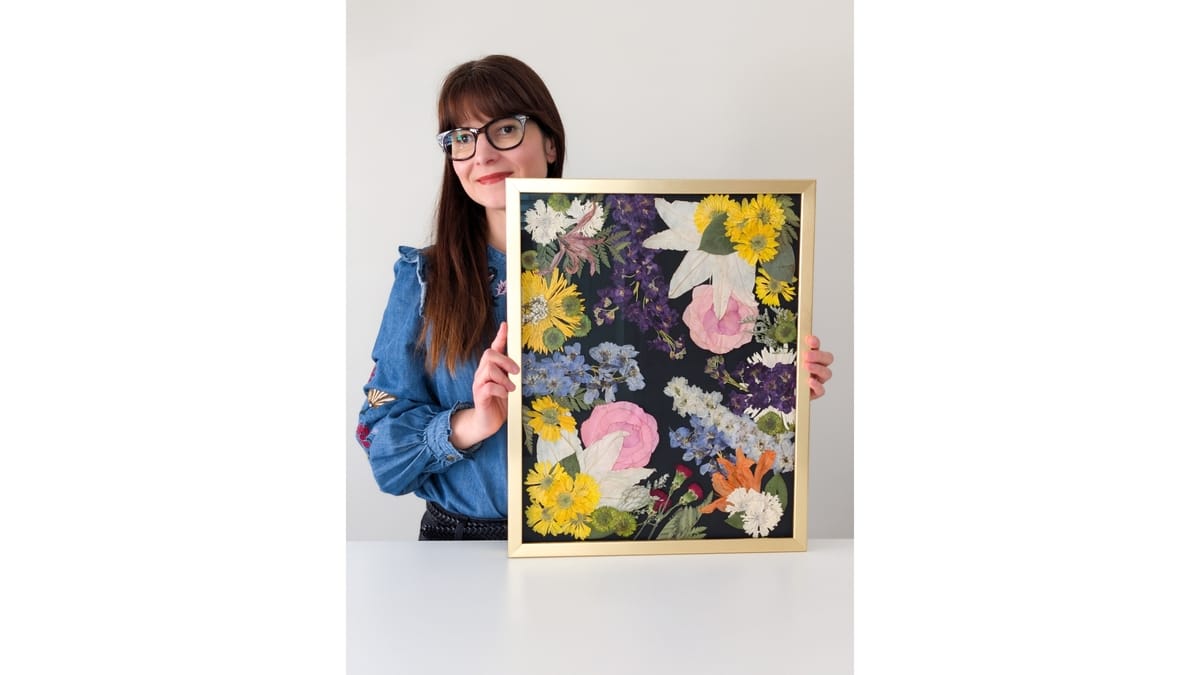
Some flowers cooperate the first time. Cosmos, pansies, larkspur, ferns, leaves.
Then there are the others.
I have been pressing professionally since 2021. Countless flowers of all kinds, both from my own cutting garden and from 400+ clients.
There are three categories of flowers:
Tricky but pressable. Just over half need a two-step method or a modified version of traditional pressing. They are tricky for a beginner but not impossible: most rose varieties, peonies, some orchids, lisianthus, dahlias, globe thistle, etc.
Nearly impossible to press or preserve. The rest, roughly one in ten, are the rebels that turn brown, lose all their color or generally are a pain, no matter what you do. Magnolias, many types of orchids, monstera, lilacs, proteas, and a few others.
This post focuses on the last two categories: the flowers that can be tamed with a few extra steps and the ones that are not worth your time.
The test that tells you what to expect
Watch what a flower does when it dies.
Lilac tells you right away. Look at a bush past peak: the wilted florets have already gone brown.
Magnolia does the same. A petal that just dropped looks perfect, and three hours later it is brown through.
The opposite signal matters too.
Mums, succulents, orchids, pittosporum and ruscus last for weeks, which tells you they hold moisture stubbornly.
And a third scenario: If a wilted or fully dried flower still retains most of its color, there’s a good chance it can be preserved with reasonably good results.
These observations will help you adjust your approach.
Two things before the list
Every method here is one you can get your hands on: traditional press, microwave press, dehydrator press, silica.
A highly specialized method (freeze drying) holds color better than all of them but is out of reach for most of us. So when I call a flower difficult, I mean difficult with the tools most of us have.
And finally, treat all of it as a starting point.
Results shift with variety, color, freshness, humidity, even microwave wattage, so expect to lose a few flowers as you learn.
The next three sections break up the “tricky to press” group into specific characteristics that make them challenging.
1. Too thick to flatten in one pass
The problem is depth, and there are two fixes depending on how dense the flower is.
The round solid ones get cut in half. Use more paper than feels necessary, close the press super tightly, tighten it again daily as the flower shrinks, and change the paper at day 2.
The petal-dense ones need two methods combined. Two days in the press, then silica, gives the flattest result. Or, silica first, then press comes out slightly thicker.
Flower | What to do |
|---|---|
Globe thistle, sea holly, craspedia, St John’s wort berries | Dense round heads with no flat side. Cut in half, tight press, tighten daily. |
Garden rose | Layers trap moisture. Press to soften, then silica. |
Dahlia, open center | Center thicker than the petals. Microwave straight through, or press with frequent paper changes. |
Dahlia, pompom | Dense the whole way through. Thin several outer rows, then microwave. Best results with bright or darker colors. |
Dahlia, fluffy and dinner plate; ranunculus; most peonies | Too much depth for any one method. Petal by petal for the most control. Darker colors: thin around the center, then microwave and press. Or silica plus press, either order. |
2. Moisture that will not leave
These hold water behind a surface that refuses to release it. You can change paper every day and still get browning, because the moisture never left.
Flower | What to do |
|---|---|
Pittosporum, Italian ruscus | Leathery leaves, and the variegated edges brown. Microwave, then press, or use a dehydrator press. |
Lisianthus | The funnel traps moisture and whites yellow. Microwave, then wooden press, or a dehydrator press. |
Tulip, daffodil | Thick tissue. Microwave, then press. |
Calla lily | Gradient colors bleach out. Microwave, then press. Deep burgundy holds best. |
Lily | Whites go translucent, and it browns easily. Stamens off first, then microwave and press. |
Orchid (Dendrobium) | Loses color in patches, unpredictable. Microwave, then press. Expect an inconsistent batch. |
Anthurium | The waxy bract browns and the spadix is far thicker. Skip as a hobbyist. For commissions: microwave, then press; cut the spadix in half and press separately. |
3. One bloom, many pieces
These look like a single flower and dry like a collection of parts. The fix is separation, slow rather than complicated.
A quick note on hydrangeas:
The woody types that bloom on old wood press easily.
The ones you cut back every fall (most common in wedding bouquets), hold a lot of water and brown, so press them floret by floret.
Flower | What to do |
|---|---|
Hydrangea, old wood | Very little moisture. Press as normal. |
Hydrangea, new growth | Holds water, browns, and the stems show through. Snip the larger florets and press individually. |
Sunflower | The center is far thicker than the petals. Deconstruct. Reduce the bulk of the center, microwave, then press. |
Mum | Hundreds of moisture-rich petals on a tiny center, and light colors fade badly or brown. Petal by petal, or thin the center, then microwave and press. |
Zinnia, coneflower | Thick wet center, thin petals. Follow my method. |
Not worth your time if you’re a hobbyist
Lilacs. Brown the moment they wilt. Garden-fresh, larger-floret varieties pressed one at a time can work. From a bouquet, plan on color correction.
Magnolias. Silica, traditional press with frequent paper changes, dehydrator. Browned every time.
Succulents. Darken to a dull brownish green after an enormous wait.
Begonias. Very high water content, very thin cell walls. Microwave and press both failed for me.
Tropical foliage. Most turn brown, so unless you color-correct, they may not be worth it.
Proteas. Sturdy, woody flowers that need full deconstruction. They air-dry well whole.
Phalaenopsis, Oncidium, Cymbidium and Vanda orchids. They lose color and brown very easily. Exception: Dendrobium orchids tend to press well with the microwave + traditional press method.
Which flower has given you the most trouble, and did you ever find a way to make it work? Tell me in the comments!
Go deeper
How to press flowers with a traditional flower press: the layering, pressure and paper-change details every method here depends on.
How to press flowers with a microwave press: the microwave phase in full, with power settings and burst timing.
How to press zinnias and coneflowers whole: the whole-flower method for thick-centered blooms.
How to press a whole rose without browning: the press-then-silica sequence.
How to stop browning and keep the color: the cause behind most of the failures in this guide.