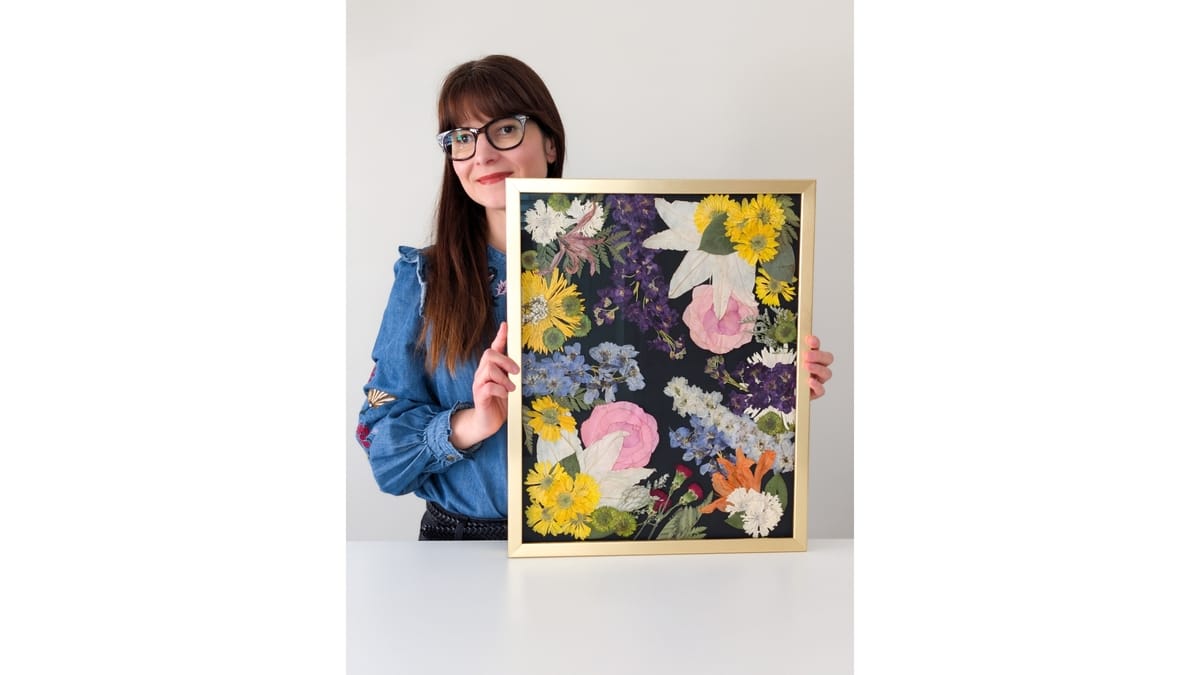

Every spring, I carry trays of seedlings out to the garden and set them in the dirt, and every spring I feel the same anticipation. These tiny plants will reward me with armloads of flowers in a couple of short months. Some of them will end up in vases. Some will go straight into the press.
If you garden in zones 5 or 6, you might assume the season starts winding down in early fall. The opposite is true for the flowers in this guide. Cosmos, dahlias, and zinnias actually hit their stride in late August and bloom through mid-October, sometimes later if frost holds off. Your garden peaks right when everyone else thinks it’s over.
And the garden itself becomes something worth lingering in. A patch of zinnias and cosmos humming with bees, butterflies drifting between dahlia blooms, a hummingbird hovering at the nasturtiums, ladybugs crawling up sunflower stems. It’s the most delightful part of my year, and I want to help you build one of your own.

Zinnia and cosmos seeds germinate incredibly fast and reliably. These babies only needed 2 days on the heat mat to sprout.
This is the companion guide to my hardy annuals article, which covers 10 cool-season flowers you can sow as early as February in zones 5 and 6. The flowers in this guide are different: they need warm soil, hate frost, and thrive in summer heat. If you’re growing for pressing, you need both groups to keep your press stocked from spring through fall.
A little about me: I’ve been growing cut flowers since 2018 and pressing professionally since 2021, with over 350 wedding bouquet commissions under my belt. Everything I share here comes from years of trial, error, and a lot of pressing paper.
These are guidelines. The best way to learn what works in your garden is to experiment.
Two more things...
Equipment: You’ll need a flower press (and ideally a microwave press) to get the most out of these flowers. Check out my articles on the traditional press and my seed-starting setup for the equipment I use myself.
Know your zone: Not sure which zone you’re in? Enter your zip code at the USDA Plant Hardiness Zone Map.
Zone 5: Last frost April 7–30 | First frost October 13–21
Zone 6: Last frost April 1–21 | First frost October 17–31
List of flowers covered in this article (click to jump to the respective section):
Before we dive in, I wanted to share two techniques specific to cutting gardens that will reward you with a bounty of flowers: pinching and harvesting.
What is pinching, and why you should do it
You’re just snipping off the growing tip of a young plant to force it to branch out instead of growing straight up. One stem becomes two. Two become four. You end up with a bushier plant that produces roughly twice as many flowers.
Here’s when to pinch each flower on this list:
Zinnias: When the plant is 8-12 inches tall, snip above a set of leaves. New branches will sprout from the leaf nodes below your cut.
Cosmos: Same approach, same height. Cosmos responds quickly and starts branching within days.
Dahlias: Pinch when the plant has 3-4 sets of true leaves. This is the hardest one to make yourself do, because dahlia seedlings grow slowly and you’ll feel like you’re setting yourself back. You’re not. Pinch.
Cinnamon basil: Pinch early and often. Every time you cut basil, it branches. The more you cut, the bushier and more productive it gets.
If you’ve never pinched a plant before, your instinct will be to leave it alone. Cutting into a perfectly healthy seedling feels wrong. Do it anyway. Your future self, surrounded by twice as many flowers, will thank you!
How harvesting gives you more flowers
Here’s something most people don’t realize about cut flowers: the more you cut, the more they produce. And not just a few extra blooms. Cutting deeply and frequently into cosmos, dahlias, and zinnias triggers the plant to send out new branches from lower nodes, which extends its productive life by weeks.
The keyword is deeply. Don’t just snip the flower head off the top of a long stem. Cut the stem as much as 12” deep or more, above a leaf node lower on the plant. This feels aggressive, especially early in the season when you don’t have many stems to spare. Do it anyway. The plant will respond by branching out from that node, and within a week or two you’ll have multiple stems where there was one.
Basil works the same way. Every time you harvest stems for bouquets or pressing, the plant branches from below the cut. A well-harvested basil plant looks nothing like an unharvested one. It’s wider, bushier, and produces far more material.
The practical upside for pressers: you get more flowers for the vase and more flowers for the press, and the plant rewards you by producing even more. It’s the rare situation where taking more actually creates more.
1. Zinnia
Pressability: ★★★☆☆ (Intermediate)
Why I love growing zinnia
Zinnias have a personal hold on me. My daughter brought home a zinnia seedling from school in 2018, a small, fateful gesture that meant more to me than she’ll ever know. Zinnias were my grandmother’s favorite flower, the one I remember best from her garden in Romania. That single seedling started a chain of events that led me from a corporate desk to a pressed-flower studio.
From a practical standpoint, zinnias are one of the most productive cut flowers you can grow. They germinate fast, grow fast, bloom fast, and if you keep cutting, they keep producing until frost takes them down. The color range is staggering, and they hold up beautifully in the vase.
Pressing them takes a little more thought than tossing a daisy in the press, especially the large double varieties. The trick is knowing which varieties to grow for pressing, and how to deconstruct the big ones when you need to.
Zinnia at a glance | |
|---|---|
When to sow seeds | Zone 5: Late March (indoors) or mid-May (direct) Zone 6: Mid-March (indoors) or early May (direct) |
When to transplant | After all danger of frost has passed |
Light requirement | Full sun |
Light for germination | No, cover seeds lightly |
Spacing | 9–12 inches |
Days to bloom | 60–70 days |
Pinching | Yes. Pinch at 8–12 inches tall above a set of leaves. |
Best varieties for pressing | Zinderella Lilac, Queen Lime series, Benary’s Giant (deconstructed), Oklahoma series, Zinnia marylandica (small singles) |
Harvest for cutting | When petals are fully open and the stem feels firm when you wiggle it (the “wiggle test”) |
Harvest for pressing | When fully open. Smaller singles: press whole. Large doubles: deconstruct. |
Vase life | 7–10 days |
Time in the press | 10–14 days (follow traditional press instructions) or 3–4 short bursts in the microwave at 80% power + 2 weeks in traditional press |
Color retention after pressing | 4/5 (darker colors hold best) |
How to grow zinnia
Start seeds indoors 4–6 weeks before your last frost date, or direct sow after all frost danger has passed and the soil is warm.
Cover seeds lightly with 1/4 inch of soil.
Germination is fast, often within 5–10 days in warm soil (70–75°F).
Space plants 9–12 inches apart. They’ll fill in quickly.
Pinch when 8–12 inches tall to encourage branching.
Water at the base, not overhead. Zinnias are prone to powdery mildew on wet foliage.
Harvest frequently and cut deeply to encourage continued branching and blooming.
Best varieties for pressing
Smaller, single-petaled varieties are the easiest to press. Zinnia marylandica types (like the Zahara or Profusion series) and the Oklahoma series have thinner flower heads that press flat without much fuss.
For larger varieties like Benary’s Giant or Queen Lime, plan on deconstructing them. Carefully pluck petals in a systematic way to thin the flower, removing evenly from different sections so the result doesn’t look lopsided. Or press petals individually and reassemble them into mandalas or abstract designs. This is actually one of my favorite things to do with zinnias. A single large bloom gives you dozens of individual petals to work with.
The Queen Lime series deserves a special mention. Those unusual lime-green and blush tones press into colors you can’t get from any other flower.
Harvesting for the press
For pressing whole, harvest smaller varieties when fully open. Use the wiggle test: grab the stem about 8 inches below the bloom and give it a gentle shake. If the stem is firm, it’s ready. If it’s bendy, wait another day.
For deconstruction, timing is less critical. You can take large blooms at full maturity and work with them on your pressing table.
Don’t forget to press...
The foliage. Zinnia leaves are rough-textured and sturdy, and they press into handsome dark green shapes. They’re especially useful as a base layer in arrangements.
How the colors hold up
Darker colors hold best. Deep reds, burgundies, and dark pinks maintain their intensity well. Lighter colors like white and pale pink will fade more noticeably over time. The unusual shades in the Queen Lime series tend to mute slightly, but they still look gorgeous because the starting point is so distinctive.
Generally, expect good color retention for the first year, with some fading after that. Darker shades can hold well for several years.
Watch out for...
Those thick, layered centers on double varieties. They hold moisture and will mold if you don’t address it. Zapping in the microwave press before transferring to the traditional press helps enormously. Change pressing paper every 48 hours for the first week.
If you’re pressing large doubles whole (without deconstructing), thin the petals first. Pull them evenly from around the flower so the remaining petals lay flat without too much overlap.
2. Cosmos
Pressability: ★★★★☆ (Beginner-Friendly)
Why I love growing cosmos
Cosmos are one of the most satisfying flowers to grow from seed. They germinate quickly, grow tall without complaining, and produce an almost absurd number of blooms once they get going. And here’s the best part: they actually prefer poor soil. No fertilizing needed. In fact, if you fertilize them, you’ll get a big leafy plant with hardly any flowers. So save your compost for something else.
For pressing, cosmos are about as easy as it gets. Those thin, flat petals press quickly and cleanly, and the delicate, feathery foliage is beautiful in arrangements. They’re the kind of flower that makes beginners feel like experts.
/
Like zinnias, cosmos take off in late summer and really hit their peak in September and October. They’re often the last annual standing before frost, still pumping out blooms when everything else has given up.
Cosmos at a glance | |
When to sow seeds | Zone 5: Late March (indoors) or mid-May (direct) Zone 6: Mid-March (indoors) or early May (direct) |
When to transplant | After all danger of frost has passed |
Light requirement | Full sun |
Light for germination | No, cover seeds lightly |
Spacing | 9–12 inches |
Days to bloom | 60–90 days |
Pinching | Yes. Pinch at 8–12 inches tall. They respond quickly. |
Best varieties for pressing | Sensation mix, Double Click (for deconstruction), Purity (white), Rubenza (deep red), Xanthos (yellow) |
Harvest for cutting | When petals are just opening and the center disc is still tight |
Harvest for pressing | When fully open with petals extended flat |
Vase life | 5–7 days |
Time in the press | 10–14 days (follow traditional press instructions) |
Color retention after pressing | 3/5 (very dark and orange varieties hold best; lighter colors fade over 1–2 years) |
How to grow cosmos
Start seeds indoors 4–6 weeks before your last frost date, or direct sow after all frost danger has passed.
Cover seeds with 1/4 inch of soil.
Germination takes 7–10 days.
Do not fertilize. Cosmos bloom better in average to poor soil. Rich soil produces lots of foliage and few flowers.
Space plants 9–12 inches apart.
Pinch at 8–12 inches tall to double your bloom count.
Stake tall varieties or plant in groups so they support each other.
Harvest frequently and deeply to keep them branching and producing.
Best varieties for pressing
Sensation mix is the classic, with big, open, daisy-like blooms in white, pink, and crimson that press beautifully. Purity (pure white) and Rubenza (deep cranberry-red) are excellent single-color options.
Xanthos is worth growing for its unusual butter-yellow color, which is rare in the cosmos world.
Avoid the puff or pom-pom varieties. Their dense, rounded centers don’t press well and trap moisture.
Harvesting for the press
Harvest when petals are fully extended and flat. The center disc should be tight and fresh, not showing seeds. Cosmos are forgiving here, giving you a generous 2–3 day window.
Don’t forget to press...
The foliage and stems. Cosmos leaves are ferny and delicate, similar to dill, and they press into beautiful wispy shapes that add airiness to any arrangement. The thin stems are useful too, adding fine lines and natural curves.
How the colors hold up
This is where cosmos are honest with you. Lighter pinks and whites will fade noticeably over 1–2 years. Very dark reds (like Rubenza) and the orange Cosmos sulphureus varieties hold their color much longer.
If color longevity matters for a specific project, lean toward the darker shades. If you’re making something you’ll enjoy for a season or two, press everything and enjoy the gradual shift toward softer tones.
Watch out for...
The center disc can hold moisture longer than the thin petals. Press face-down for better air circulation and change paper after 2–3 days. Cosmos are thin enough that this is rarely a major problem, though.
3. Dahlia
Pressability: ★★☆☆☆ (Advanced)
Why I love growing dahlia
Dahlias are show-stoppers. The color range, the petal formations, the sheer size of some dinner-plate varieties. There’s nothing subtle about a dahlia, and that’s exactly why people love them. For wedding bouquet preservation (my professional specialty), dahlias are one of the most requested flowers.
They’re also one of the most challenging to press. All those layered petals trap moisture, and the thick center resists flattening. But I’ve pressed hundreds of dahlias over the years, and I can tell you this: the microwave press changes everything. What used to be a dice roll with the traditional press becomes reliably beautiful with the right technique.
Dahlias grow from tubers, not seeds, which means a different process than everything else on this list. They’re also the last flowers to bloom in your garden, really hitting their stride in late August through October, often producing their best work right before frost.
Dahlia at a glance | |
When to plant tubers | Zone 5: Mid-May (after last frost) Zone 6: Early May (after last frost) |
Can start indoors | Yes, 4–6 weeks before last frost in pots |
Light requirement | Full sun (8+ hours) |
Spacing | 18–24 inches |
Days to bloom | 90–120 days from planting |
Pinching | Yes. Pinch when the plant has 3–4 sets of true leaves. |
Best varieties for pressing | Smaller pompon types, single-flowered varieties, collarette types. Dinner-plates work beautifully deconstructed. |
Harvest for cutting | When the outer petals are fully open and the back petals feel firm |
Harvest for pressing | When fully open. Deconstruct as needed. |
Vase life | 5–7 days |
Time in the press | 3–5 bursts for 35 seconds at 80% power until 80–90% dry, then 2 weeks in traditional press with 2–3 paper changes |
Color retention after pressing | 4/5 (darker colors hold best) |
How to grow dahlia
Plant tubers outdoors after your last frost date, when the soil has warmed. Or start them in pots indoors 4–6 weeks earlier for a head start.
Dig a hole 4–6 inches deep. Add a handful of bonemeal fertilizer. Lay the tuber flat with the eye (growing point) facing up.
Water very sparingly until you see green growth emerging. Tubers rot easily in cold, wet soil.
Space plants 12–24 inches apart, depending on variety.
Stake at planting time. Dahlias get top-heavy and will topple without support.
Pinch when the plant has 3–4 sets of true leaves.
Harvest frequently and deeply to encourage branching.
In zones 5–6, dig up tubers after the first frost and store them in a cool, dry place for next year.
Best varieties for pressing
Smaller dahlia types are easier to press whole. Ball and pompon varieties, single-flowered types, and collarette dahlias all have manageable petal counts and flatten reasonably well.
For dinner-plate dahlias and other large, densely petaled varieties, plan on deconstructing. Carefully remove some petals before pressing, or press petals individually. I love pressing individual dahlia petals because each one is a little work of art on its own. A single bloom can yield 30–50 individual petals for creative work.
Don’t be afraid to experiment. I’ve been surprised by varieties I expected to fail in the press.
Harvesting for the press
Harvest when the outer petals are fully open and the bloom looks lush. For pressing, timing is less critical than technique, because you’ll be using the microwave press.
Don’t forget to press...
The foliage. Dahlia leaves are large, deeply lobed, and press into dramatic shapes. Press them separately from the flowers since they’re quite thick.
How the colors hold up
Dark reds, burgundies, and deep purples hold their color well. Lighter colors like blush and pale yellow fade faster. Orange dahlias are somewhere in the middle, keeping their warmth for a good while before softening.
The same general rule applies here as everywhere: the darker the starting color, the longer it holds.
Watch out for...
Moisture is the enemy with dahlias. All those layered petals create pockets where water hides. This is why the microwave press is so valuable. Zap them in the microwave until they’re 80–90% dry, then transfer to a traditional press [link to traditional press article] for the final 2 weeks, changing paper 2–3 times during that period.
If you try to press a large dahlia in a traditional press without microwaving first, you’ll likely end up with moldy petals and a lot of frustration.
4. Amaranth
Pressability: ★★★★☆ (Beginner-Friendly)
Why I love growing amaranth
Amaranth is one of those flowers that makes people stop and ask, “What is that?” Those long, draping flower heads in deep reds, burgundies, and greens look like something from a fairy tale. They add a completely different texture to pressed arrangements. While most pressed flowers are flat and circular, amaranth gives you flowing, cascading shapes.
Growing it is straightforward. Amaranth loves heat, tolerates poor soil, and grows fast once the weather warms up. Give it a sunny spot and stand back.
Amaranth at a glance | |
When to sow seeds | Zone 5: Mid-March (indoors) Zone 6: Early March (indoors) |
When to transplant | After all danger of frost has passed and soil is warm |
Light requirement | Full sun |
Light for germination | Yes, surface sow or barely cover |
Spacing | 12–18 inches |
Days to bloom | 75–90 days |
Pinching | No |
Best varieties for pressing | Love Lies Bleeding, Red Garnet, Green Tails |
Harvest for cutting | When flower tassels are fully developed and showing color |
Harvest for pressing | When tassels are fully developed and showing full color |
Vase life | 7–10 days |
Time in the press | 10–14 days (follow traditional press instructions) |
Color retention after pressing | 4/5 (reds hold well, greens may fade slightly) |
How to grow amaranth
Start seeds indoors 6–8 weeks before your last frost date.
Surface sow or barely cover seeds. They need light to germinate.
Use a heat mat. Germination takes about 7 days at 70–75°F.
Transplant outdoors after all frost danger has passed and the soil has warmed up.
Space plants 12–18 inches apart.
No staking needed for most varieties. Minimal water once established.
Best varieties for pressing
Love Lies Bleeding is the classic, with those dramatic, rope-like tassels that can drape over a foot long. Red Garnet has a more upright form. Green Tails offers an unusual chartreuse option that contrasts beautifully with reds and purples in arrangements.
Harvesting for the press
Harvest when the flower tassels are fully developed and showing their full color. The stems are thick, so use sharp pruners.
Don’t forget to press...
The leaves are beautiful, but remove them from the flower head before pressing. They tend to crinkle and curl when pressed alongside the tassels. Press them separately, flat and on their own, and they’ll turn out much better.
How the colors hold up
Reds hold their depth well. Green varieties may shift slightly toward yellow over time, but they still look good. The deep burgundy shades are among the most stable.
Watch out for...
You’ll need a large press to accommodate the long flower heads. If your press isn’t big enough, you can arrange the tassels to curve or fold gently to fit, or cut them into shorter sections.
The main pressing challenge is avoiding overlapping “branches” in the flower head. Take time to spread them out flat and arrange them before closing the press. Thin out sections if needed for an even result.
5. Cinnamon Basil
Pressability: ★★★★★ (Beginner-Friendly)
Why I love growing cinnamon basil
This one surprises people. Cinnamon basil in a pressing guide? But hear me out. Basil is a wonderful filler in bouquets, highly aromatic, and holds up surprisingly well in the vase. The cinnamon variety has beautiful purple-tinged stems, dark green leaves, and pretty little flower spikes that add an unexpected element to pressed arrangements.
Most people think of basil as a kitchen herb and nothing more. The cut flower world knows better. A few stems of cinnamon basil tucked into a bouquet add fragrance and a lush, leafy backdrop that makes the flowers pop.
For pressing, it behaves like regular foliage. Simple, forgiving, and useful.
Cinnamon basil at a glance | |
When to sow seeds | Zone 5: Mid-March (indoors) Zone 6: Early March (indoors) |
When to transplant | After all danger of frost has passed and soil is consistently warm |
Light requirement | Full sun |
Light for germination | Yes, surface sow or barely cover |
Spacing | 8–12 inches |
Days to bloom | 60–75 days |
Pinching | Yes. Pinch early and often. Every cut triggers branching. |
Best varieties for pressing | Any cinnamon basil variety |
Harvest for cutting | Harvest stems before flowers fully open for longest vase life |
Harvest for pressing | Harvest leafy stems at any stage |
Vase life | 5–7 days |
Time in the press | 10–14 days (follow traditional press instructions) |
Color retention after pressing | 4/5 (greens hold well, purple tones may darken slightly) |
How to grow cinnamon basil
Start seeds indoors 6–8 weeks before your last frost date.
Surface sow or barely cover seeds. They need light to germinate.
Use a heat mat. Germination takes about 10 days at 65–70°F.
Transplant outdoors after all frost danger has passed. Basil is very frost-sensitive.
Space plants 8–12 inches apart.
Pinch early and often. Every time you cut basil, it branches from below the cut. A well-harvested basil plant becomes bushier and more productive with every harvest.
Handle gently. Basil leaves bruise easily.
Best varieties for pressing
Any cinnamon basil variety works. The appeal is in the foliage, the aromatic leaves, and the purple-tinged stems. The small flower spikes are also worth pressing for an unusual textural element.
Harvesting for the press
Harvest leafy stems at any stage. For pressing, you want the leaves to be fresh and undamaged. Cut stems in the morning after the dew has dried. Follow the traditional press instructions in my dedicated article [link to traditional press article].
Don’t forget to press...
The flower spikes. They’re small and delicate, pressing into charming little architectural elements.
How the colors hold up
The green leaves hold their color well. Purple tones on the stems may darken slightly over time, which actually adds to their appeal.
Watch out for...
Overlapping leaves. Basil stems have dense leaf coverage, so thin them out before pressing. Remove leaves that overlap and press them in a single layer. If you try to press a full, leafy stem without thinning, you’ll get a lumpy, uneven result with moisture trapped between layers.
6. Dwarf Sunflower
Pressability: ★★★★☆ (Beginner-Friendly)
Why I love growing dwarf sunflower
There’s something about sunflowers that makes you smile. Even the dwarf varieties, with their compact, manageable blooms, have that same warm, sunny energy as their giant cousins. And for pressing, dwarf sunflowers are far more practical. They fit in a standard press, the petals are proportional, and the center discs are small enough to flatten without a fight.
They’re also one of the fastest flowers from seed to bloom, often flowering within 50–60 days. Quick wins for impatient growers.
Dwarf Sunflower at a glance | |
When to sow seeds | Zone 5: Mid-May (direct sow) Zone 6: Early May (direct sow) |
Light requirement | Full sun |
Light for germination | No, plant 1 inch deep |
Spacing | 6–9 inches |
Days to bloom | 50–65 days |
Pinching | No |
Best varieties for pressing | Any dwarf variety (Teddy Bear, Sunspot, Elf, Little Becka, Suntastic) |
Harvest for cutting | When petals are fully extended and center is still tight |
Harvest for pressing | When petals are fully extended. Press whole or deconstructed. |
Vase life | 7–10 days |
Time in the press | 10–14 days (follow traditional press instructions) |
Color retention after pressing | 3/5 (may fade in 1–2 years, typical for sunflowers) |
How to grow dwarf sunflower
Direct sow seeds after all frost danger has passed and the soil is warm.
Plant seeds 1 inch deep and 6–9 inches apart.
Germination is fast, typically 7–10 days in warm soil.
Water regularly until established, then they’re fairly drought tolerant.
For a longer season of blooms, succession plant every 2–3 weeks.
No staking needed for dwarf varieties.
Best varieties for pressing
Any dwarf sunflower variety works well. Teddy Bear has fluffy double blooms that are fun to deconstruct. Sunspot produces classic single blooms on short plants. Little Becka has unusual red and yellow bicolor petals.
The variety matters less than the size. As long as it’s dwarf, you’re in good shape.
Harvesting for the press
Harvest when petals are fully extended and the center disc is still tight. Follow the traditional press instructions in my dedicated article [link to traditional press article]. Dwarf sunflowers press beautifully whole or deconstructed, so experiment with both approaches.
Don’t forget to press...
The leaves and thin stems. Sunflower leaves are heart-shaped and textured, and they press into lovely green shapes. The thin stems add a natural, organic line to arrangements.
How the colors hold up
Yellows will fade over 1–2 years. This is on par with sunflowers generally. Enjoy them while they’re vibrant, and accept the gradual softening. The darker center discs hold their color well.
Watch out for...
The center disc can hold moisture, as with most daisy-family flowers. Press face-down for air circulation and change paper after 2–3 days. For larger dwarf varieties, consider pressing the center separately from the petals.
Where I get my seeds
My go-to sources are Johnny’s Selected Seeds, Eden Brothers, Burpee’s, Baker Creek, The Gardeners Workshop, and Floret. I’ve had the best germination rates with Floret and Baker Creek (though they carry a more limited range of cut flowers). I have been buying dahlia tubers consistently from Swan Island Dahlias. The quality is superb and the prices are very reasonable.
Whatever source you choose, look for varieties bred for cutting rather than bedding. The stems will be longer, the flowers larger, and you’ll have much more to work with when it’s time to press.
A summer cutting garden grown with pressing in mind is one of the most rewarding things you can nurture. You get months of beauty in the garden, armloads of flowers for your home, and a collection of pressed treasures that last for years. Start with one or two flowers from this list if eight feels like too many. Zinnias and cosmos are the easiest place to begin.
Now your turn!
What are you planning to grow and press this summer? I’d love to hear about your garden plans in the comments!