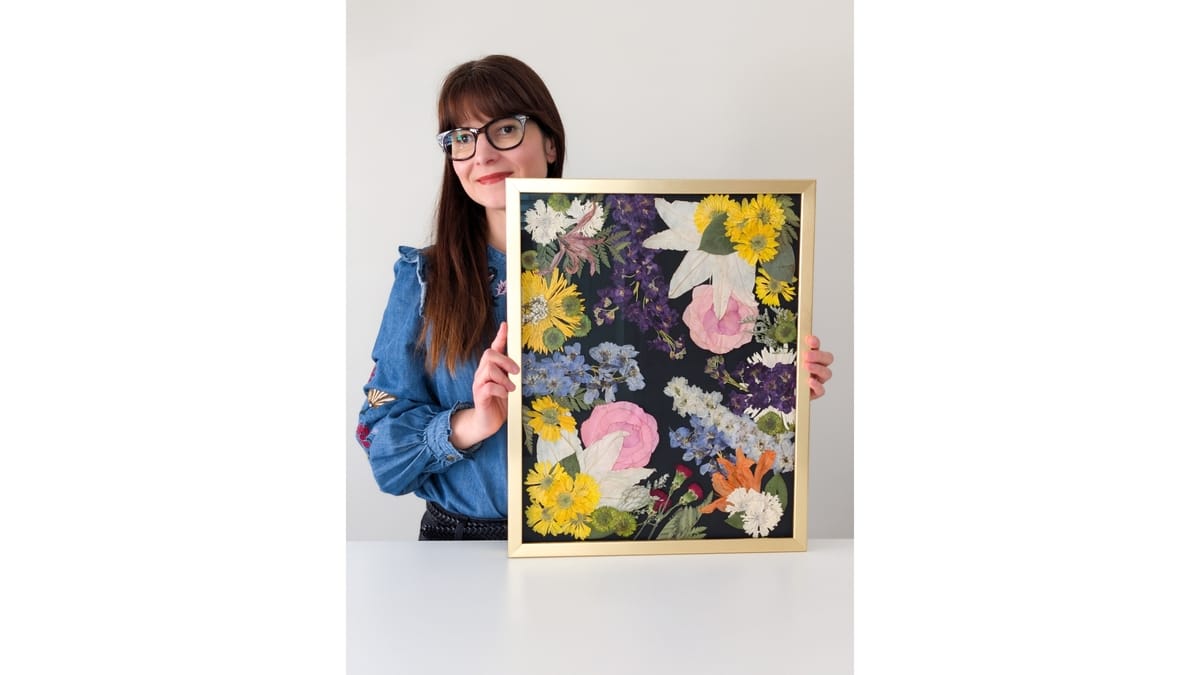
After pressing tens of thousands of flowers over the past five years, I still reach for a microwave press almost every week. Most microwave press tutorials are made by people who have tried the method once on a Saturday afternoon. This guide is not that. It’s what I have learned about microwave pressing as a working flower preservation artist who uses it weekly, alongside three other methods, on commissions where mistakes are not an option.
Quick origin story, since it explains a lot about how I think about this tool. In 2021, I bought a Microfleur 9X9” press as a complete beginner. I had read great reviews about color retention, and I wanted instant results. The problem: my own garden had no hydrangeas, and I really wanted to try the method on something showy.
So I started “stealing” them. On evening walks, I would snip a few oakleaf hydrangea blooms from my neighbor's garden, slip them into my pocket, and walk briskly home with my heart racing a little.
Those stolen blush-pink hydrangeas came out of my new Microfleur looking so beautiful that I went all in. I started pressing everything I could get my hands on.
Five years later, the microwave press is no longer my main tool, but it has earned its place in my professional work. It is one of four methods I use, and it does specific things that no other method can. Let's talk about what those things are, how to do them well, and what it actually takes to get professional-quality results from this method.

My well-loved Microfleur has seen a few things in my studio!
Should you buy a microwave press?
You can find a dozen tutorials online that show you how to press flowers using a paper towel, a dinner plate, and your microwave. You can also build a DIY press out of two ceramic tiles and felt sheets from the craft store. These methods exist, they cost almost nothing, and for an afternoon of crafting with your kids, they are perfectly fine.
For anyone who wants to take this craft seriously, hobbyist or professional, I recommend the original 9×9” Microfleur. I have used my two presses almost weekly for five years. It’s patented for a reason, and the cheap knock-offs will disappoint you.
Why microwave pressing works (and why it sometimes doesn't)
Microwave ovens heat water molecules from the inside out. That rapid moisture extraction is what allows you to dry a flower in minutes instead of weeks, and it is also why microwave-pressed flowers often retain better color than book-pressed ones. Slow drying gives pigments time to break down. Fast drying locks them in.
The catch is that fast drying also locks in mistakes. Press a flower too long, or at too high a power, and you don't dry it. You cook it. The thin petals burn while the thick center is still damp. White flowers brown. Pastels lose their delicacy. The very thing that makes the method powerful is what makes it unforgiving.
You will see some flower pressers online insisting that flowers should be "pressed, not cooked," meaning the microwave is somehow inferior or unprofessional. I disagree. The right method is whatever produces the best result for that specific flower, and for some flowers, the microwave is the only method that works at all.
The conditioning step nobody talks about
Before your first-ever pressing session and after any extended period of disuse, the wool pads inside your Microfleur need to be conditioned. This is the single most important step that almost no tutorial mentions. Skipping it is the fastest way to burn your pads and ruin your flowers.
The wool pads do the actual work of pulling moisture out of the flower. If the pads are bone-dry when you start, and your flower is small or low-moisture, there isn't enough water in the system to absorb the heat. The result is scorched wool and a scorched flower.
To condition the pads, mist them lightly with water on both sides or dab them with a damp paper towel. Then assemble the press, put it in the microwave, and run it for about 20 seconds at 80% power. That introduces enough moisture into the pads to do their job.
If your press has been sitting unused for a few weeks, the pads will dry out and need to be reconditioned before your next session. Same step, same time, same power. It takes 30 seconds and saves a lot of frustration.
The pressing process, step by step
Here is what you will need to actually press a flower:
Your Microfleur, with conditioned pads
Fresh flowers harvested in the morning after the dew has dried
Scissors or pruners for trimming stems
A paper towel or dishcloth for wiping condensation between bursts
If you’re pressing roses, gently open them up from the inside out and remove the bulk of petals in the middle.

Removing the bulk will help produce better results. Always remove from the center out.
Lay your flowers face down on the cotton liner. Don't let petals or leaves overlap. They will stick together, and unsticking them later is hard. Leave a little space around each flower.

Don’t forget about the leaves! They will dry faster, so keep an eye on them.
Where you place flowers in the press matters more than most people realize. Flowers near the edges dry faster than flowers in the middle, because steam escapes more easily at the perimeter. After three or four bursts, you'll start noticing the difference. To minimize the effect, avoid putting flowers in the dead center of the press. Cluster them around the perimeter and just keep an eye on overall timing.
Power level is your safety control. I work at 80% in my old, low-wattage microwave dedicated to flower pressing. If you have a newer, more powerful oven (1100 watts or higher), drop to 70% for the first few sessions while you learn how your specific microwave behaves. There is no universal timing chart that works across all kitchens. You have to learn yours.
Your first burst is the longest. In my professional work, I run it for 40 seconds at 80%. If you are new and nervous, start at 30 seconds and see what happens.

This is how they look after the first burst.
After the first burst, take the press out of the microwave and open it up. There will be steam and condensation. Let it air for about a minute, and wipe the inside of the plastic plates with a paper towel. This step matters. Trapped moisture slows everything down and increases your risk of cooking the flower.

Wipe the excess water from the plates in between bursts.
This is also the moment to fix any folded petals. Right after the first burst, the flower is still soft and pliable. You can gently unfold a creased petal with your fingertip or carefully with tweezers, and it will stay that way. Once it dries, whatever shape it has is permanent.
For subsequent bursts, go shorter. The flower has less moisture now, which means less water to absorb the microwave energy, which means more risk of burning. I usually go 35 seconds for the second burst, 25 for the third, and 15 to 20 for any after that.
To know when a flower is done: gently try to bend it down the middle. If it bends easily, it needs more time. If it stays stiff and resists, it's dry.
A medium rose with two or three rows of petals will need significantly more time than a few pansies, simply because there is more organic matter holding more moisture. Don't compare timing across flower types. Each one finds its own pace.

Done! They are wrinkly, which is why I no longer fully press with this method. Instead, I put the flowers in a traditional press after the 2nd burst for most flowers.
Best and worst performers
The single biggest predictor of success in a microwave press is color. Brightly colored and deeply saturated flowers retain their pigment beautifully. White and pastel flowers are the highest-risk category for browning, regardless of how careful you are.
The flowers I press in the microwave with consistent success include:
Roses, especially when combined with a traditional press finish
Hydrangea, including oakleaf
Dahlias, thinned out first
Peonies in colored varieties, also thinned
Delphinium
Lilies in any color
Tulips
Daffodils
Scabiosa, also called pincushion. I always start these in the microwave.
Orchids, with the caveat that some varieties lose color and that is normal
Lisianthus, with the caveat that white lisianthus turns yellow. Expected, not a failure.
Tropicals, especially anthurium
Anthurium deserves a special note. The microwave press is the only method I have found that works for them. Every other method browns them. If you press tropicals, the microwave is non-negotiable.
The flowers I avoid in the microwave include:
Mums, especially white. They turn an ugly brown-gray. Brightly colored mums (red, magenta, rusty brown) fare somewhat better, but they are tricky across the board.
Gerbera daisies. They do better in a traditional press with frequent paper changes.
White flowers as a category. Some are workable. Most are not.
For thick flowers like roses, dahlias, and peonies, you will need to thin the petals before pressing. For most thick flowers, I randomly remove petals from the middle rows so the final result doesn't have visible gaps near the center.
Roses get a different approach. Flex down the outer two or three layers of petals, then gently pull out the inner petals one by one. You end up with a clean, open rose face. Place it face down in the press for better control over how the petals lie flat.
The hybrid method: microwave first, traditional press second
Here is the most important workflow in this entire post. If you want professional-quality results from a microwave press, you almost always need a second method to finish the job.
The microwave is your moisture extractor. It is excellent at pulling water out of a flower fast. It is less good at producing the smooth, flat, watercolor finish that elevates pressed flower work. Microwave-only flowers can come out looking slightly wrinkled or smooshed, which is what the "pressed not cooked" critics are reacting to. Their complaint about the finish has merit. Their proposed solution (abandon the microwave entirely) does not.
The fix: use the microwave to dry the flower 80 to 90% of the way, then move it into a traditional press for the final finish.
Here is a real example from a bridal commission I pressed recently. I had four medium roses to press. They fit into my 9x9 Microfleur with room to spare.
Burst 1: 40 seconds at 80%
Burst 2: 35 seconds at 80%
Burst 3: 25 seconds at 80%
At that point, the roses were about 60% dry. I moved them into my dehydrator foam press to finish, because for these particular roses, the foam press gives me better color retention than a traditional press would. If you don't have a foam press available, you can absolutely use a traditional press. Plan to check the paper at 48 hours, change it once, and let the roses sit for another week or so. Total time in the traditional press: about nine days.
The microwave should always be the first step in any combination. Microwave first, traditional press second. Going the other direction doesn’t produce good results.
One thing to flag: pressing roses whole using this method is actually harder than pressing them petal by petal. It takes more confidence and experience. The petal-by-petal method is the safest route to avoiding browning, and it is what I recommend if you are still building your skills. Whole-rose pressing is the direction I am moving in my own work because I love the natural look it produces, but in my opinion, it is the next-level technique, not the starter.
Pressing flowers from a bridal bouquet
If you preserve wedding flowers, the microwave press deserves a specific role in your workflow, and that role changes by season.
After hundreds of commissions, I see three rough categories of bouquets:
Spring bouquets tend to have a high proportion of microwave-friendly flowers: tulips, roses, and peonies. These benefit most from the microwave-first, traditional-press-second method.
Summer bouquets are usually a mix. Garden-style bouquets with roses, dahlias, wildflowers, and delphinium need a flower-by-flower decision. Some go in the microwave first, some go straight to the traditional press, some get pressed petal by petal.
Fall bouquets are mostly traditional press territory. They tend to feature heritage mums, amaranth, and certain dahlia varieties that don't respond well to heat. The microwave doesn't usually earn a spot in my fall preservation work.
Roses get one extra prep step before they go anywhere near the press. I cut the stem to about 1-2 inches below the bloom, lay the rose on a flat surface with air circulation, and let it soften for a few hours to a full day. Supermarket roses take longer to soften because they are bred to stay tight. Garden roses soften quickly and wilt even faster, so move quickly with them.
The rose is ready when you can gently try to open the outer petals and they flop instead of snap.
Care and maintenance
The cotton fabric liners will stain over time from colorful flowers. The stains don't transfer to your flowers, but the fabric eventually gets stiff and looks unpleasant. About 3-4 times a year, I soak the cotton with diluted bleach for about an hour, then hand-wash and rinse. Take it from someone who has ruined several shirts: don't splash bleach on your clothes!
Wool pads need to stay conditioned. If you press regularly, just keep an eye on whether the pads feel papery dry between sessions. If you go a few weeks without pressing, recondition before your next session.
Burning will happen at some point. Most burns are small, often invisible in the finished flower, and the flower itself is usually still usable. Burns happen for two reasons: pads weren't conditioned, or you didn't reduce time and power as the flower dried. Both are easy to prevent once you know the cause.
Troubleshooting the most common problems
Your flower comes out of the press looking great, then goes soft or wrinkled the next day.
It wasn't fully dry. The microwave got it most of the way there, and the last bit of internal moisture eventually rehydrated the petals and softened them. The fix: put the flower in a traditional press for a week to finish drying. This is also why I almost always finish microwave-pressed flowers in a traditional press now. Underestimating drying time is the single biggest mistake I see beginners make. A 95% dry flower will fail later. Plan for that.
Your flowers brown in the middle while the edges look perfect.
This is the edges-faster-than-center problem. Reduce your burst length and be patient with the center. If the edges look done but the center is still soft, give it a short 15-second burst at 70%, then check again.
Your flower sticks to the cotton fabric.
Don't pull at the flower. Gently tug at the edge of the cotton fabric, and the flower will release. If you pull at the petals, you'll tear them.
You smell burning wool.
Stop the microwave. Open the press. Let everything cool. The pads emit a distinctive bad smell when they scorch, and that smell is your warning system. Most likely, the pads weren't conditioned, or your last burst was too long. Reduce time and power, recondition the pads, and continue.
A note on the skeptics
Some flower pressers argue that microwave pressing fails most of the time and is unsuitable for serious work. I disagree.
Pressing whole flowers in the microwave actually requires more skill than deconstructing them petal by petal. The natural, organic look you can achieve by combining the microwave method and traditional pressing is an aesthetic in its own right.
Where I will agree with the skeptics: A flower pressed only in the microwave can have a slightly “cooked” look that doesn't suit every style. Combine the microwave with a traditional press finish, and that problem disappears almost entirely.
Where the microwave press fits in my work today
The microwave press is where I started, and it is still part of my professional toolkit. It’s my first step for tropicals, certain roses, lisianthus, scabiosa, hydrangea, and a handful of others. After the microwave does its job, most of my flowers move into a traditional press or a dehydrator press to finish.
That is just what happens when you understand what a tool actually does, and what it doesn't.
If you are starting your pressing journey or building toward professional work, get a 9x9” Microfleur as your first investment. Learn its limits. Then add the methods that fill in those limits, and you will have a workflow that handles almost anything.
What surprised you most when you started pressing flowers in a microwave? I would love to hear what worked, what failed, and what you are still figuring out. Drop a comment below.
Some links on this page are Amazon affiliate links. If you purchase through them, I earn a small commission at no extra cost to you. I only link to products I personally use in my own studio.