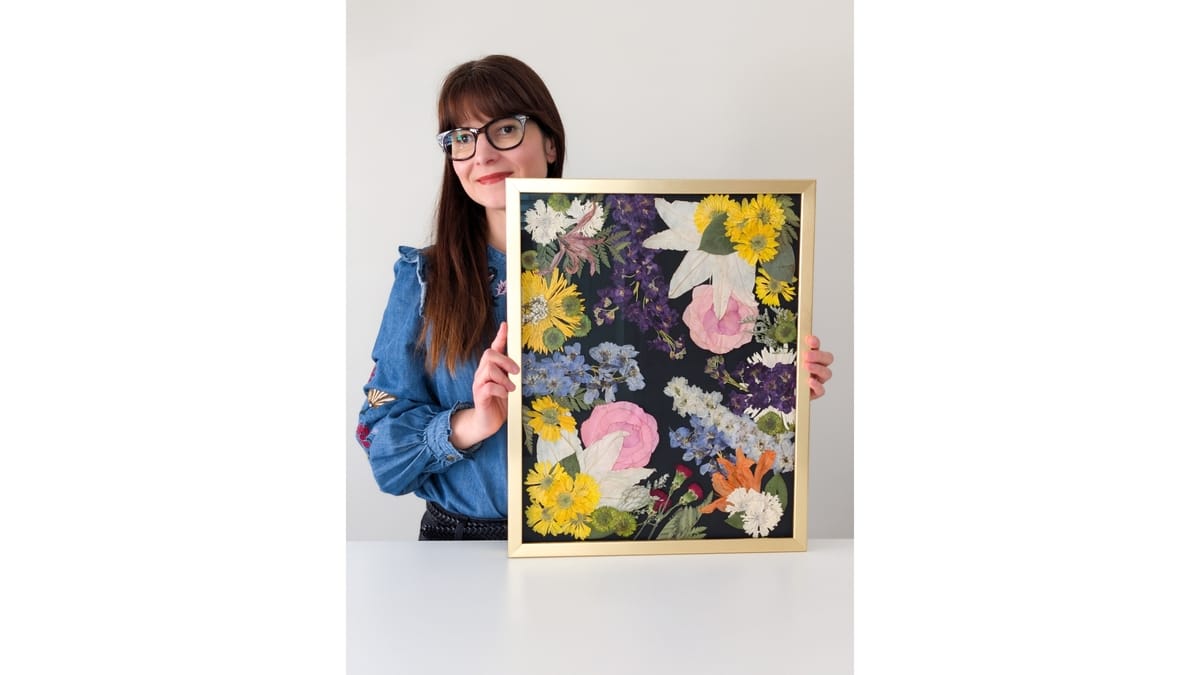

My flower preservation practice wouldn't exist without my cutting garden. In fact, it was my unexpected love for growing cut flowers from seed that led me to change the course of my life, from a cog in the corporate world to a pressed flower artist.
There was a time when I thought gardening was a chore, a waste of time. That changed in 2018 when my young daughter brought home a zinnia seedling she had grown at school. It was a small, fateful gesture that meant more to me than she will ever know. Zinnias were my grandmother's favorite flowers. Her magnificent garden was the most beautiful in her neighborhood and my favorite place in the entire world to hide during long summer days, study bugs, and get my hands really dirty.
So in 2018, I decided to grow a few vegetables and flowers from seed in the only sunny area of our Chicagoland property: the front yard. I took flower-farming classes during the pandemic and gradually expanded my garden to several raised beds and containers.
Growing, tending, and pressing flowers from my garden is the most rewarding and nourishing thing I've ever done for myself. I want to share this joy with you through this guide to growing and pressing some of the most beautiful flowers I've ever grown.
These 10 flowers face cold springs like champs and press beautifully. They're forgiving of mistakes (everybody kills flowers, even experienced growers). Whether you're in Zone 5 or 6, these guidelines will get you started. But remember, they're guidelines! The best way to learn what works in your garden is to experiment.
Two more things…
Equipment: You will need a few items to get your seeds started. Check out this article I wrote about the equipment I use myself.
Know your zone: Not sure which zone you're in? Enter your zip code at the USDA Plant Hardiness Zone Map:
Zone 5: Last frost April 7–30 | First frost October 13–21
Zone 6: Last frost April 1–21 | First frost October 17–31
List of flowers covered in this article (click to jump to the respective section):
1. Anemone
Also known as: Windflower
Pressability: ★★★☆☆ (Intermediate)
Why I love growing anemone
There's a reason everybody swoons over anemones. Those jewel-toned petals surrounding dramatic dark centers? Pure magic. And when you press them fresh from your garden, harvested that morning, they retain a vibrancy that store-bought flowers simply can't match.
Yes, they grow from corms instead of seeds, which means a slightly different process. But don't let that intimidate you! Once you get the hang of soaking and planting those funny little dried nuggets, you'll be rewarded with some of the most stunning pressed flowers in your collection.

Jewel-toned anemones and sweet peas from my 2022 garden
Anemone at a glance

How to sprout anemone corms
Anemones grow from corms, not seeds, which means a slightly different process. Here's how to get them started:
Soak corms in room-temperature water for 4-6 hours until they roughly double in size. Don't go longer than 8 hours or waterlogged corms can rot before they ever get going.
Plant in flat trays filled with moist potting mix, about 2 inches apart. Can't tell which end is up? You're not alone! Just plant them sideways, and they'll figure it out.
Keep them cool (40-50°F) for 2-3 weeks until green shoots appear.
Time your pre-sprouting based on your zone: Zone 5, start soaking in late February for early April transplanting. Zone 6, start in early February for mid-March transplanting.
They may need grow lights to reduce "legginess" (the shoots will stretch for light, making the seedling lanky and weak).
Transplant after your last hard frost, setting them 2-3 inches deep and 4-6 inches apart.
Water the seedlings with a nitrogen-based fertilizer (I like Neptune's Harvest) after transplanting and weekly until they start to take off.
Best varieties for pressing
Go with De Caen or St. Brigid types. De Caen has single rows of petals that press perfectly flat, with no overlap to worry about. St. Brigid varieties are ruffled and gorgeous, but the extra petals need more careful arrangement.
Color tip: Deep reds ('Hollandia') and rich purples ('Mr. Fokker') hold their color beautifully after pressing. White varieties ('The Bride') press clean but can brown if your timing's off.
Harvesting for the press
Here's the tricky part with anemones: the harvest window is narrow. You want petals fully unfurled, but before any pollen dust appears on those dark centers.
The good news? You'll develop an eye for it quickly. Look for completely flat petals (not cupped), a tight dark center, and no visible pollen. That window lasts about 12-24 hours per bloom. Harvest in the morning after the dew dries.
Don't forget to press...
The foliage! Those deeply divided, fernlike leaves press into delicate, lacy shapes that make gorgeous background elements. I harvest leaves from the base of the plant, and they press flat without any fuss.
Honestly, the buds aren't worth pressing. They compress into unremarkable little shapes. Save your pressing paper for the open blooms.
How the colors hold up
It depends on the color. Dark reds actually deepen slightly and retain about 80% of their intensity, with stunning results. Purples hold well but may shift a few shades toward blue. Whites stay clean if you dry them quickly.
The main color concern is those dramatic dark centers. They can bleed onto petals if you don't remove moisture quickly enough. Change your pressing paper after 2-3 days and you'll avoid most problems.

Gorgeous pressed anemones and ranunculus from my 2022 garden
Watch out for...
The thick center holds water longer than those thin petals. If you don't address this, you get crispy petals around a moldy center, which is not the look we're going for! Solution: Change your paper after every 2 days until they are mostly dry.
St. Brigid varieties can trap moisture where petals overlap. For stubborn specimens, I sometimes separate petals and press them individually, then reassemble in the final artwork. More work, but worth it for those ruffled beauties.
Also known as: Cornflower
Pressability: ★★★★★ (Beginner-Friendly)
If you want reliable blue in your pressed flower art, this is your flower. I've pressed thousands of flowers over the years, and very few hold their blue the way bachelor's buttons do. Most blues fade to muddy gray or shift toward purple. Bachelor's buttons? They stay true.
They're also incredibly forgiving, both in the garden and in the press. Drought-tolerant, frost-hardy, and happy to reseed themselves. If you're new to growing flowers for pressing, start here. Seriously.


Bachelor's buttons are one of the easiest flowers to grow from seed, making them perfect for beginners.
Direct sow seeds outdoors in early spring, as soon as the soil can be worked. They actually prefer cool weather for germination.
Cover seeds lightly with about 1/4 inch of soil. They need darkness to germinate.
Keep soil moist until germination, which takes 7-14 days.
Thin seedlings to 4 inches apart once they have their first true leaves.
No fertilizer needed. They actually bloom better in poor to average soil.
For continuous blooms, succession plant every 2-3 weeks through mid-spring.
Best varieties for pressing
Blue Boy is the classic, with that saturated, true blue that's hard to beat. But don't overlook Black Magic (deep maroon, almost black when pressed) or the Polka Dot mix if you want variety.
Skip the double varieties. Those overlapping petals trap moisture and don't press as cleanly. Stick with singles for pressing.
Harvesting for the press
Bachelor's button gives you a generous harvest window of 2-3 days, which is practically an eternity compared to more finicky flowers. Even slightly past-prime blooms press well, just with a more "vintage" look as outer petals reflex. No panic required with these!
Don't forget to press...
The silvery-green foliage is totally underrated. Those slender, lance-shaped leaves press flat with zero effort and add beautiful linear texture to arrangements.
Buds work surprisingly well too. They press into tight, silvery spheres, perfect for filling small gaps in designs.
How the colors hold up
Excellent, among the best of any flower. Blue varieties maintain about 90% of their color intensity even after a year in a frame. This is genuinely rare!
Pinks and whites hold well, too. The reds (like Black Magic) can shift slightly toward burgundy over time, but they stay rich and beautiful.
Watch out for...
The only real issue is the center, which holds moisture longer than the petals. If you press before it's fully dry, you'll get browning in the middle while the petals look perfect.
Easy fix: press face-down so the center gets air circulation, and change your pressing paper after 2-3 days.
3. Calendula
Also known as: Pot Marigold
Pressability: ★★★★☆ (Beginner-Friendly)
Why I love growing calendula
Calendula is pure sunshine in flower form. Those bright orange and yellow petals practically glow, bringing warmth and cheer to any pressed arrangement. And from a growing perspective? Almost foolproof.
They germinate fast (often within a week!), tolerate poor soil, bloom continuously if you deadhead, and self-sow enthusiastically. Plus, they handle light frost without complaint, which extends your growing and harvesting window on both ends of the season. What's not to love?
Calendula at a glance

How to grow calendula
Calendula is wonderfully straightforward and one of the fastest flowers from seed to bloom.
Direct sow seeds outdoors after the last hard frost, or start indoors 4-6 weeks earlier.
Cover seeds with 1/4 inch of soil. They germinate best in darkness.
Germination is fast, often within 5-7 days in warm soil.
Thin seedlings to 6 inches apart.
Water regularly but avoid overhead watering, which can promote powdery mildew.
Deadhead spent blooms to encourage continuous flowering.
They struggle in the summer heat. Expect a pause in blooming during the hottest weeks, then a fall resurgence.
Best varieties for pressing
Pacific Beauty mix offers a lovely range of oranges, yellows, and apricots with nice, long stems. Resina and Erfurter Orangefarbige are high-resin varieties grown for medicinal use, but their intense orange color makes them fantastic for pressing too.
Double varieties create fuller pressed flowers but need more attention during drying. Singles are more predictable if you're just starting out.