Most flower pressing advice online stops in the same place. Pick fresh flowers, change your paper, keep them out of direct light once dry.
All true, and all the things I read in my first year too.
The trouble is that they got me to a passable pressed flower and then left me stranded, because the problems that actually slowed me down were never in those tutorials.
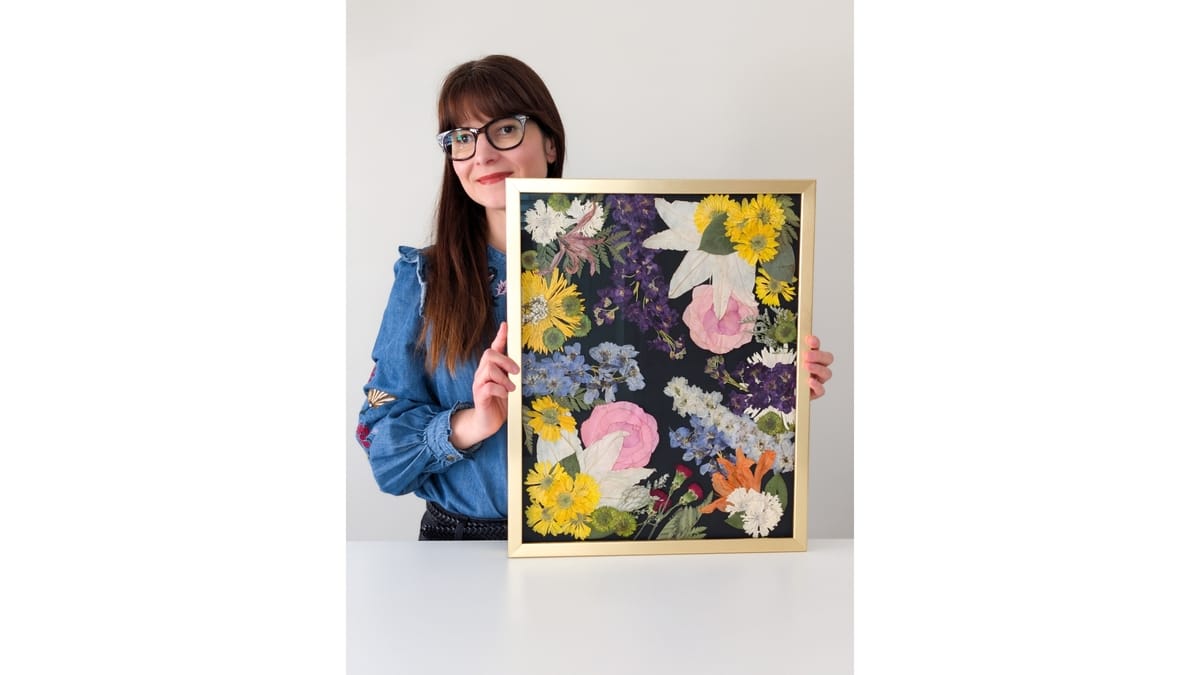
I run a flower preservation studio now, and most of what I know came from getting it wrong first, on my own garden flowers and, more nerve-wracking, on bouquets a bride handed me to keep forever.
These are the techniques I'd press into my past self's hands if I could.
A few will save you weeks. One or two might change how you think about what pressing even is.
1. Three basics will take you almost anywhere
Before you buy a single specialty gadget, know this: you can press and arrange roughly 95% of flowers with three things:
a larger, solid-wood press with bolts (not the dinky strap kind),
plenty of plain copy paper plus some fine corrugated cardboard, and
a good acid-free glue.
The press I keep coming back to is large enough to fit two sheets of paper side by side, which matters more than you'd think once you're pressing in any volume.
Stock up on copy or blotting paper and fine corrugated cardboard refills that won't leave imprints, and use Lineco acid-free adhesive for mounting.
The specifics shift by flower (how often you change paper, how long you leave it), but the kit doesn't need to grow nearly as fast as you might think.
I go through my full studio setup in my tools and equipment post if you want the deeper list.
2. Fresh flowers matter more than perfect technique
You'll hear some pressers say that a faded or browned flower means you did something wrong in the press.
That's only partly true.
It's worth untangling, because it leads a lot of people to blame their hands for a problem that started before the flower ever went between the paper.
Technique can absolutely cause browning.
But if a flower wasn't fresh and well-hydrated when you pressed it, no amount of perfect paper changes will bring its color back.
A flower that's already past its prime is carrying the beginnings of decay with it, and the press just preserves whatever state you gave it.
Start with flowers at their peak, and you've won half the battle before you begin.
I break down all the ways color goes wrong in my post on why pressed flowers turn brown.
3. Use plenty of pressure from the start
There's advice floating around that you should press gently at first and tighten later, to let air move around the petals.
I've tried it both ways, and for the flowers most people are working with, I don't agree.
Water-heavy petals want firm, even pressure right away.
Go too light, and you get wrinkles, curled edges, and petals that dry in a shape you never intended.
The pressure is what holds everything flat while the moisture leaves, and an under-tightened press is one of the most common reasons a pressing comes out looking lumpy rather than crisp.
Crank those bolts down!
I cover the mechanics of getting it right in my traditional press guide.
4. Match the method to the flower
This is the one skill that the rest of this list feeds into. Instead of using one method for everything, read the flower first: how much water is it holding, and how is it built?
A thick, “juicy” bloom like a dahlia or orchid gets a couple of rounds in a microwave press to pull moisture fast, then a transfer to a traditional press to finish flat.
(Here's my full microwave press method.)
A waxy, heat-unpredictable flower like a hellebore I keep away from the microwave entirely, because the quick heat shifts its color in ways I can't control (more on that in my hellebores post).
And tiny, fragile things like feverfew or chamomile go on jumbo pads, which cradle them where stiff paper would crush them.
The cotton pad method is one of my favorites.
5. Taking flowers apart to press isn't “cheating”
Roses, peonies, dahlias, anything with row upon row of overlapping petals, will trap moisture in the center and rot from the inside if you press them whole.
The fix:
take the flower apart,
press the petals individually, and
then rebuild the bloom in your finished piece, layering the outer rows back in around a center so it reads as a whole flower again.
Here's what I wish someone had told me sooner, though, and it isn't about technique.
For a long time I resisted deconstructing flowers because it felt like cheating. Like taking a rose apart wasn't “pure” enough, and a real presser would be skilled enough to press it whole.
That was ego talking, and it held my work back for longer than I'd like to admit.
Knowing when to take a flower apart IS the skill.
The reassembly is where the artistry lives.
I walk through the gluing and rebuilding side of it in my complete gluing guide, and the precision tweezers and applicator bottles I use make the fiddly parts manageable.
6. Press flowers in different positions, and press more than the bloom
One flower is not one design element.
Press the same bloom opened flat, folded to show its profile, or angled, and you end up with a little set of shapes that all came from the same plant.
When you sit down to compose a piece, having that range is the difference between a flat arrangement and one with depth and movement.
And don't stop at the flower.
The stems, the leaves, the foliage you'd normally toss into the compost are some of the most useful things you can have on hand.
Hellebore leaves, for instance, press beautifully with no special treatment and make a gorgeous background layer.
Once you start seeing a plant as a collection of pressable parts rather than just its prettiest face, your work opens up.
7. Don't be afraid of color-correction
Reds and pinks keep shifting, some whites brown, some yellows fade completely, fast.
Pressing slows the color story down, but it doesn't always end it.
The freeing part is that you can put color back.
I won't pretend there's a single recipe here, because there isn't. The real learning comes from experimenting on flowers you don't mind sacrificing.
But the mindset shift alone is worth everything: color is something you can shape, not a verdict the press hands down.
If you're staring at a washed-out pressing right now, don't toss it. It might be your next experiment!
8. Use archival materials, especially if you sell
The work you do after the press decides whether a piece survives a decade or a season.
Oxygen and light are the real enemies of pressed flower color, and the way you finish a piece is your defense.
Acid-free mats keep your mounting from yellowing and eating at the flowers over time, and UV-protective glass slows the fading that light causes.
If you're selling your work, this matters twice over.
UV glass is worth the cost:
it protects the piece, and
it answers the question every buyer asks: “will it fade?”
It won't stop fading completely, and you should be honest about that, but it delays it meaningfully.
Reaching for archival materials tells a buyer your work is made to last.
9. A bonus principle: err on the side of more
If there's one principle underneath all of this, it's this:
Give yourself more slack than you think you need!
More paper. More time after the last paper change. More extra flowers. A bigger press than seems reasonable. More storage space than you can imagine filling.
Flower pressing is a hobby that balloons (no point in hiding it from you!).
It starts as a few blooms in a phone book and somehow becomes a full-blown business and thousands of stored specimens.
Building in that extra room from the start means you're not constantly running short. It lets you experiment freely, which is how you actually get better.
Generosity with your materials is generosity with your own learning.
My storage guide has details once your collection outgrows a shoebox.
Every one of these came from doing it the slow, frustrating way first, which is exactly why I wanted to hand them to you now.
You'll still make your own mistakes (that's where the best lessons hide), but maybe a few of these will save you a season or two.
Which of these do you wish you'd known when you started? And what would you add to the list? Tell me in the comments!
———
Some links on this page are Amazon affiliate links. If you purchase through them, I earn a small commission at no extra cost to you. I only link to products I personally use in my own studio.