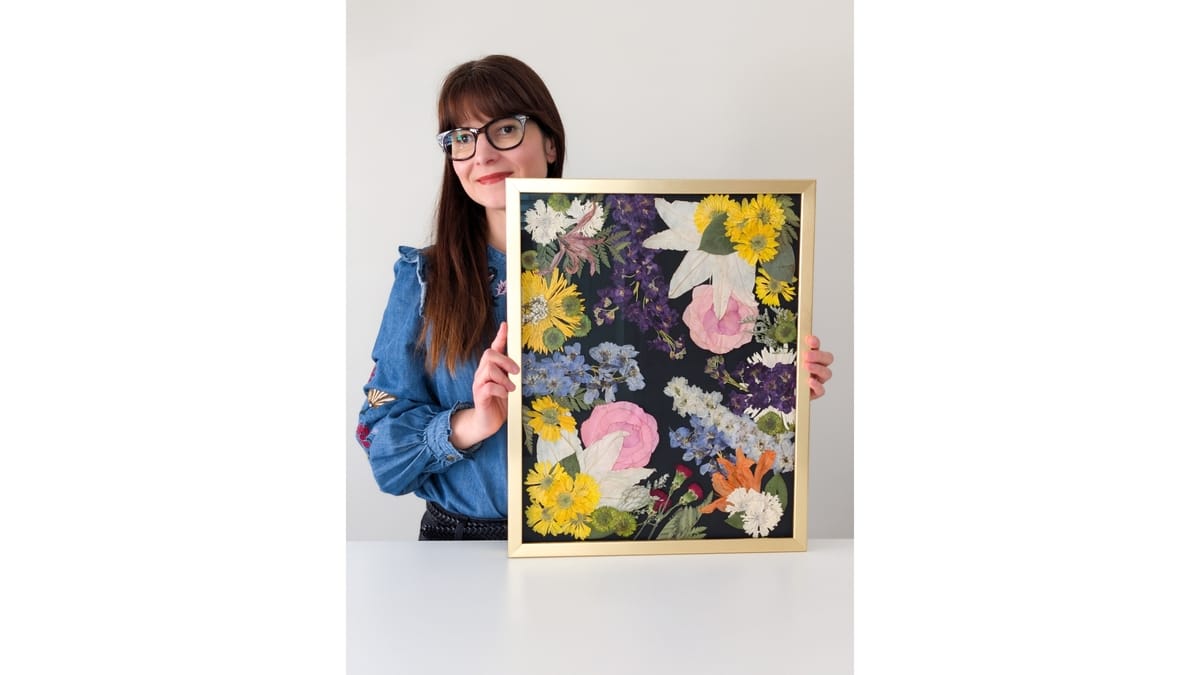
Gluing is the step that separates a piece you'd hang in your own home from one you'd send to a paying client, and almost no one teaches it well.
I started pressing flowers in 2021 and went pro later that year. Across more than 350 wedding bouquet commissions, I've tested most of the glues and applicators the craft world recommends. I've ruined work, fixed work, and once paid to replace a frame after a commission came loose. Everything in this post is what I actually use now, after years of trying everything else.
This post focuses on technique, materials, and tools. If you want to start at the beginning of the pressing journey, my full guide on using a traditional flower press is the right place to land first.
The glue I left behind
When I started pressing as a hobbyist, I used Mod Podge. The internet pointed me toward it and it seemed reasonable. I made a decorative wall hanging out of polymer clay discs that I shaped and baked myself, connected the discs with rings, and glued a single pressed flower onto each one. To finish them, I brushed several coats of Mod Podge over the flowers as a sealant.

A detail from the wall hanging I made and sold. Although Mod Podge enhances the anemone's textured center, the brushstrokes are visible.
It looked fine at first, though you could see brush streaks from the multiple coats. I sold one of those wall hangings to a friend. About a year later, she sent me a photo. Part of one of the flowers had peeled off the polymer clay and broken away, leaving a small hole in the artwork.
That was the moment I realized Mod Podge is a craft glue, not an archival adhesive. Once someone is paying you for your work, it doesn't meet the bar. Pressed flowers are organic material, and they need an adhesive that's pH-neutral and acid-free so the flower doesn't break down or discolor over time. Mod Podge is great for a card you're making for fun. For anything you want to last, you'll want something archival.
I now use three glues in both my professional and personal work. They're simple, widely available, and they cover everything I need.
Lineco archival glue: the workhorse
When I reach for it. About 75 to 80 percent of my gluing happens with Lineco Neutral pH adhesive. It's the standard archival glue used across the professional pressed flower world. It's clear-drying, acid-free, and safe for organic material. For most pressed flowers and foliage with a flat surface, this is the right answer.
When it's the wrong choice. Lineco isn't a universal answer though. It struggles with three things: thick or 3D flowers, flowers dried in silica that retain dimensional shape, and very fine lacy material like ferns and asparagus fern. It also doesn't hold well on coarse, woody surfaces like branches or poppy pods. Use a different method for those.
The most important rule. Use it sparingly. Tiny dots, never a full coat. The temptation when you're starting out is to lay it on thick so the flower really sticks, but resist the urge! On thin petals like poppies or sweet peas, too much glue will actually damage the flower and show through the petal. The thinner the flower, the less glue you need.

The precision applicator bottle lets you dot glue on the backs of delicate flowers. I hands-down recommend this approach over brushes!
An important technique variation
The small dot application works in most cases, but sometimes you need to apply glue with a brush instead. If you’re opting for a deconstructed design, where you arrange petals and greenery individually, apply glue to the entire surface of each piece to ensure they fully adhere to the paper or glass.
Gorilla spray adhesive: the specialist
When I reach for it. About 10 percent of the time, on materials nothing else can handle. Fine ferns, asparagus fern, larkspur foliage, baby's breath, evergreen branches, and certain spring vines with thread-thin tendrils. Anything where a precision tip would shred the material and a brush would soak it. In my experience, the Gorilla spray glue is the only practical method for these.
Realities of working with spray. It's messy. The aerosol mist drifts and sticks to everything around you, so good ventilation matters. I work in a room with an air purifier, and I always spray onto a large piece of cardboard that catches overspray. Outside works too, as long as you're not spraying downwind. The nozzle clogs over time. There are tricks to clear it, but I recently had to throw away a half-full can because the nozzle was beyond saving. Keep a backup.
The one-shot rule. Once a sprayed flower touches your paper or glass, it's there. There's no repositioning. Practice your placement before you spray. I'll come back to this in the technique section because it applies to all three glues, but with spray, it's absolute.
How I actually apply it. I lay the flower or foliage face down on cardboard, hold the can about six to eight inches above, and spray a light, even coat onto the back. Then I lift the piece with tweezers and place it where I've already practiced putting it. Don't spray your fingers (ask me how I know). The mist sticks instantly, and then your fingers stick to the flower, and it's a whole situation.

Gorilla glue spray is a great product for fine, detailed botanicals like this pressed lilac. Make sure you apply to the correct side; it’s easier than you think to mix them up! In this case, the back is not color corrected.
The gerbera daisy trick
Gerberas are notorious for falling apart after pressing. The hundreds of tiny petals are anchored to a small central area, and when that area dries and shrinks, the petals start detaching one by one. I learned this the hard way and had to rebuild several gerberas before I figured out the fix.
Right after I take a gerbera out of the press, I lay it face up on cardboard and lightly spray Gorilla adhesive across the top of the flower. The glue locks the petals to the central disc and prevents shedding in storage. Apply lightly enough that the sheen is rarely an issue once the piece is framed. If you do see a slight gloss after drying, gently dab a color-matched pan pastel across the surface to dull it. Most of the time you won't need to.
Hot glue gun: for 3D flowers and woody material
When I reach for it. When I'm working with 3D pressed flowers in a shadow box, or with woody and dimensional botanicals like branches, poppy pods, or anything else without a smooth flat surface. Lineco can't hold these. Hot glue can. I use it more than people might expect because so much of my professional work combines flat pressed flowers with dimensional dried elements.
The gun itself. Nothing fancy. I use a standard hot glue gun that cost me $6-7. There are higher-end models with precision temperature control, and they're lovely if you want to splurge. But truly, you don't need them. The basic gun and standard glue sticks work for everything I do. Keep a generous stack of sticks on hand because you go through them fast.
How to apply it. On the back of the flower, a dot in the center plus a thin line halfway out toward the edge. That gives you secure contact without spreading glue across the full back of the petal. Never coat the entire back of a flower with hot glue. The glue will create visible lumps and damage the petal.

I chose to apply hot glue to this Italian ruscus foliage because of its uneven surface. Lineco glue or Gorialla spray would not be sufficient.
The repositioning window. About eight seconds total. Three seconds to apply the glue, three or four seconds to place the flower before the glue sets. Be precise about where you're putting it. Once it cools, it's set.
When to never use it. On delicate flowers like sweet peas, poppies, or anything with thin papery petals. The heat will burn the petals, and even if it doesn't, the glue itself will leave a visible bump. Use Lineco for delicate flowers, every time.
The other thing to never do. Don't use hot glue on glass. I'll get into the why in the floating frame section, but it's a rule I learned the hard way (more on that below).
The tool change that saved me hours: precision tip bottles
For my first few years pressing, I applied Lineco with a brush. Most of the existing pressed flower content tells you to do this. It works. It's also slow, wasteful, and frustrating in ways I didn't fully realize until I switched.
The brush problem. Lineco glue dries within minutes if you put it on a small ceramic tile or palette. That meant constantly pouring fresh glue, constantly washing the brush before its bristles seized up, and constantly scrubbing the palette. When I'm in a flow state and I want to focus on the flowers, the last thing I need is a maintenance task between every application. Brushes also push you toward over-applying. The bristles hold more glue than you need, so you end up with too much on the petal and the glue shows through.
The switch. Then one day I saw a resin artist on Instagram using small, precision-tip squeeze bottles with thin metal tips, and a lightbulb went off. I bought a pack from Amazon to try with my Lineco glue. They changed how I work. Search for "precision tip applicator bottles" on Amazon, and you'll find several brands. They're all roughly the same. Buy a small size, not a large one, because the smaller bottles force you to refill more often, and the glue inside stays fresh.
Don't thin the glue. You'll see advice online to thin Lineco with water before applying. Skip it. Thinning adds water back into a flower you've spent weeks drying. Pour the glue straight from the bottle into the applicator. It will flow through the precision tip without any modification.
Care and maintenance. Always cap the tip after a session. Without the cap, the metal tip clogs as the glue dries inside. To clear a clogged tip mid-session, push a sewing pin or thin needle into the metal tube. That clears most clogs. Eventually, a bottle will clog beyond saving, and you'll replace it. That's why I keep a small supply on hand.
Why this matters. The bottles let me apply tiny, precise dots and thin lines. I use a fraction of the glue I used to. I don't over-apply, which means the glue doesn't show through delicate petals. I don't lose flow time washing brushes. The whole rhythm of gluing got faster and cleaner.

This Italian ruscus piece is flat, so Lineco glue is a great option.
Tweezers matter too. I use two styles, both from Amazon. Fine-pointed tweezers for delicate flowers, where I can slide the tip gently under a petal without crushing it. Rounded-tip tweezers for thicker, heavier flowers. You can find the ones I have here. Tweezers loosen over time as you use them. The tips stop meeting cleanly and they grip less reliably. When that happens, replace them. I keep a few backups in the studio.

The two types of tweezers I use the most: fine pointed for delicate flowers and rounded for larger, sturdier elements.
How I actually glue a flower
Here's the full sequence I use for a flat pressed flower with one row of petals.
1. Choose the placement first. Before any glue touches anything, lift the flower with tweezers and set it down where you want it on the paper or backing. Look at it from a few angles. Adjust. This is your measure-twice-cut-once moment. Most beginner mistakes happen because someone applies glue before they've committed to the placement.
2. Flip the flower face down. Turn it over on a clean surface so the back is exposed.
3. Trace the petal edges with tiny dots. Using the precision tip bottle, lay a series of small dots along the outer edge of every petal. You're outlining the flower, not coating it. Then add a few interior dots toward the center for additional contact.
4. Lift, flip, and place. With fine-pointed tweezers, lift the flower carefully, flip it back over, and lower it into the spot you already chose. Don't slide it across the paper. Set it down.
5. Don't second-guess yourself. Once the glued flower is on the paper, leave it where it landed. Trying to lift and reposition almost always tears the petals or smudges glue across the surface. If the placement was off, chalk it up to practice and try again with the next one.
The variation for very thin flowers
For very delicate material like poppies, where any glue on the petal will show through, I sometimes apply glue to the paper instead of to the flower. I lay down a small amount of Lineco where the flower will sit, then use the tip of my ring finger to spread it into a thin even film. Then I lower the flower onto the prepared spot.
This is a 1-percent-of-the-time technique for me. About 99 percent of my gluing is glue-on-the-flower. But for the very thinnest petals, paper-side glue can save a flower that would otherwise be ruined.

My trusty gluing tools.
Gluing on glass is its own challenge
Floating frames are popular and I understand the appeal. The flower seems to hover between two panes of glass with no visible backing. They're also one of the reasons I no longer offer floating frames in my professional work, and the gluing is a big part of why.
Glass is smooth. There's no surface texture for the glue to grip. Adhesion that feels secure on paper can fail on glass over weeks or months, especially with temperature swings or humidity. I learned this the hard way with one of my early commissions. I used hot glue and a bit of spray to attach a leaf to the glass on a floating-style frame. After the client picked it up, the leaf came loose and fell to the bottom of the frame. I had to retrieve the piece, break the seal on the frame to fix it, and buy a replacement frame. Costly mistake. Lesson learned permanently.
Hot glue: don't use it on glass. It can't get a reliable grip on a smooth surface, and the bond will eventually fail. After the leaf-falling commission, this became one of my hard-and-fast rules.
Lineco: works, with adjustments. On glass, you need more dots than on paper. Same precision tip technique, same edge tracing, but add more interior dots so the petal has multiple anchor points. Apply carefully because excess glue smudges the glass and is much harder to clean off than to prevent.
Combining Lineco and Gorilla spray. For thicker flowers on glass that don't have a smooth back, you can use both. Lineco for the contact points, a light spray pass for additional surface adhesion. The combination gives me confidence that the piece will hold.
Drying time on glass is longer. Give pieces glued to glass at least 6 hours to dry before you seal a frame. Watch the glue color through the back of the glass: it shifts from milky white when wet to a barely visible, translucent shade when dry. If the glue still looks white, give it more time before you close the frame!
The mistakes I see most often
Over-applying glue. You don't need to glue every millimeter of every petal. For frames, where the glass protects the flower, leaving some petal edges unglued actually helps the piece feel three-dimensional rather than flat. The exception is greeting cards or anything that won't be framed, where you need full adhesion because the flower is exposed.
Spraying acrylic sealant or fixative on top of finished work. Acrylic sprays are formulated for paint and inorganic surfaces, and you don't know how they'll interact with organic flower material over time. They also leave a visible residue, even when the can says "dries clear." If your flowers are glued and going under glass in a frame, they don't need any topcoat. The frame is the seal.
Hairspray. Whoever started this advice online should be stopped - I'm willing to die on this hill! Don't spray hairspray on pressed flowers as a sealant.
Hobby work vs commission work
I get this question a lot: do I use different methods for paying clients than for my own art? The honest answer is no. The fundamentals of gluing are the same regardless of who the work is for. Lineco for most flowers, Gorilla spray for fine elements, hot glue for 3D and woody material. Precision tip bottles. Practiced placement. Sparing application.
What changes is my tolerance for any flower that isn't perfectly secure. On personal work, I might let a small detail slide. On a commission, if I have any doubt about whether a flower is truly attached, I redo it. The technique is identical, but the bar for finished work is higher.

This client commission includes all three gluing methods I described in this article: hot glue for 3D peonies, roses and some of the ruscus; Lineco for the sweetpeas, tulips and stock; and Gorilla spray for the vines along the bottom.
Frequently asked questions
What's the best glue for pressed flowers?
It depends on the flower. For most flat pressed flowers and foliage, Lineco Neutral pH archival glue is the right answer and what I use about 75 to 80 percent of the time. For fine lacy material like ferns and asparagus fern, use Gorilla spray adhesive. For 3D pressed flowers and woody botanicals, a hot glue gun. The methods section above explains when to use which.
Can you use Mod Podge or Elmer's glue for pressed flowers?
For casual hobby projects you'll keep on a shelf, sure. For anything you want to last or anything you plan to sell, no. Mod Podge and Elmer's are craft glues, not archival adhesives. They're not pH-neutral and they can break down over time, which means flowers can yellow, peel, or fall away from the backing. I sold a Mod Podge piece early in my pressing days and it failed within a year. Once I switched to Lineco, the failures stopped.
How do you glue pressed flowers onto glass for a floating frame?
Lineco with extra dots for security, sometimes combined with a light pass of Gorilla spray for thicker flowers. Never hot glue. Allow at least six hours of dry time and check the glue color shift from milky white to translucent before you close the frame.
How do you clean dried glue residue off glass?
For Lineco residue, dip a Q-tip in 95 percent isopropyl alcohol and gently work it across the residue. Patience matters more than pressure. For more stubborn glue, especially Gorilla spray that's fully dried, switch the Q-tip to acetone, but use it sparingly because acetone can leave its own smudges if you over-saturate. If you need to lift something physically, use a wooden toothpick. Avoid metal blades, please! They'll scratch the glass and there's no coming back from that.
How do you glue fine greenery like ferns, asparagus fern, or baby's breath without ruining them?
Gorilla spray adhesive. Trying to glue these with a brush or precision tip will tear them and waste your time. Spray works because the glue applies evenly across every thread of the material at once. Practice your placement before you spray, because spray is one-shot. Once it's down, it's there. Spray onto cardboard to catch overspray, work in a ventilated area, and apply lightly. The technique is in the Gorilla spray section above.
Will the glue change the color of my pressed flowers?
I've used Lineco for years and have not seen it cause discoloration in normal use, but there are two exceptions.
First, if you over-apply on a very thin petal, the excess glue can show through the petal once dry. That isn't discoloration so much as visible wet glue. Switching from a brush to precision tip bottles eliminated this for me almost entirely.
Second, if you use glued flowers in resin work before the glue is fully dry, the wet glue can react with the resin and discolor the flower. I once watched a pink rose turn purple in a resin coaster because there was still wet glue on one petal. The fix is to confirm the glue is fully dry before pouring resin. If you live somewhere humid, you can speed drying with the oven trick I describe in my guide on storing pressed flowers.
How do I keep petals from curling up after I've glued them down?
Curling happens when the petal edges aren't anchored, especially in humid environments. The fix is to add a few small glue dots near the very edge of each petal so the edge has somewhere to grip. For pieces going under glass that sits raised above the flower, edge dots matter more because the petal has room to lift. For pieces where the glass sits directly on the flower, less of an issue.
Can you reposition a pressed flower after you've glued it down?
It depends on the glue. Lineco gives you a small window of about 10 to 15 seconds before the glue starts to grip, but moving the flower during that window often tears petals. Gorilla spray gives you no window. Once it touches the surface, it's there. Hot glue gives you about eight seconds total: three to apply, three or four to place. The honest answer is that you avoid repositioning by practicing placement before you ever apply glue. Measure twice, cut once.
If you're earlier in the pressing journey and gluing isn't your problem yet, my complete guide to using a traditional flower press walks through the equipment, layering, and timing in the same level of detail.
Which of these glues have you tried, and which one surprised you the most, in either direction? Tell me in the comments!
Some links on this page are Amazon affiliate links. If you purchase through them, I earn a small commission at no extra cost to you. I only link to products I personally use in my own studio.
What topics are you most interested in?
1