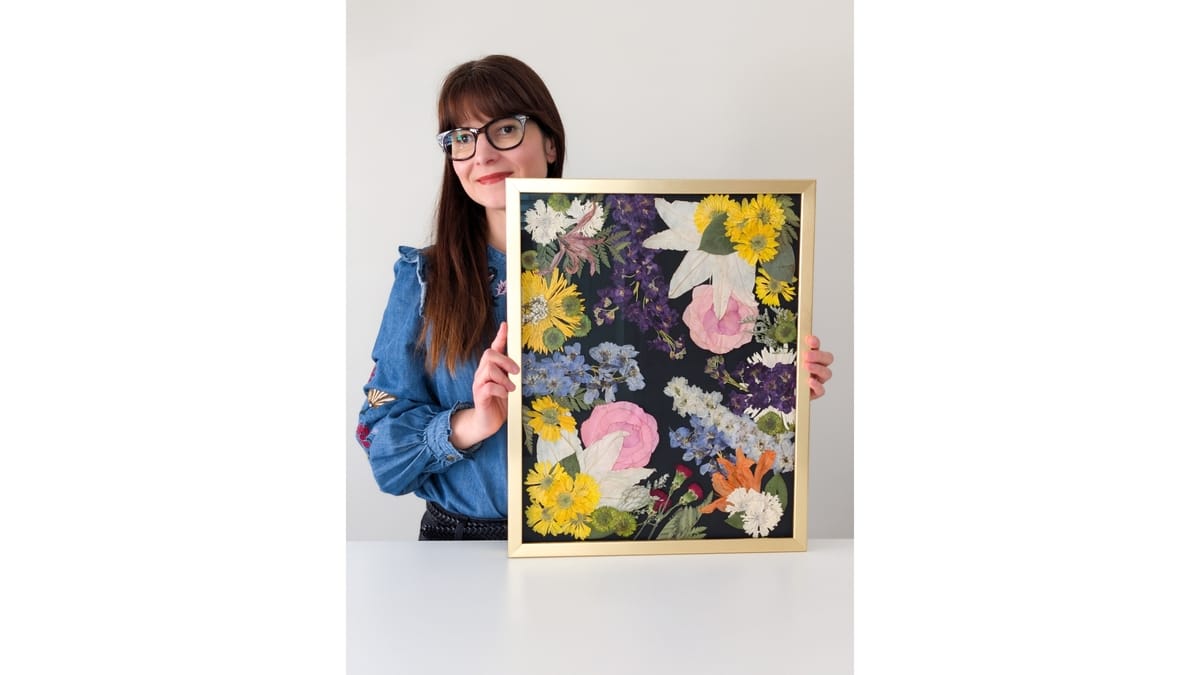

In 2021, I started pressing flowers with a microwave press and whatever paper I had lying around. I had no idea what I needed. I just started.
Since then, I have pressed over 10,000 flowers, completed hundreds of wedding bouquet commissions, and gone through enough trial and error to know exactly which tools earn permanent shelf space and which ones do not. This is the list of products I actually use.
If you’re just starting out, I curated a list of items that will set you up for success and will grow with your skills (also, don’t miss my detailed guide to pressing with a traditional press). The full list of equipment in my studio follows. You don’t need everything on the list, of course, but it’s a good reference point if (or when) you decide to scale your practice and sell or take commissions.
If you have any questions, drop a comment at the end - I read and answer all!
Equipment and tools for beginner pressers
Copy paper or blotting paper, A4, 100 sheets
Full list of flower pressing equipment, tools and supplies
Flower presses & refill kits
The Microfleur is where my pressing journey started and it still earns a spot in my workflow, but I rely on traditional wooden presses. I settled on the BestNest presses because they are solid and large enough to fit two sheets of paper side by side. If you’re pressing in volume, I recommend the cardboard refill kits. It’s the type of finer corrugated cardboard that won’t leave imprints on your flowers.
BestNest Nature Press, 12" x 18" - They are sturdy and well-made. Drill larger holes to fit longer bolts, if you want.
BestNest Nature Press Refill Kit, 12" x 18" - the press comes with up to 10 pieces of cardboard and paper. I have several refills because of the large volume of flowers I press
Microfleur microwave flower press kit, 9 × 9" - I own two, they are the best! Skip the cheap knock-offs.
Microfleur microwave press refill pack, 9 × 9" - I burned many a pad when I was just starting out, so it’s good to have a refill handy.

Blotting paper & cotton pads
While you can use regular copy paper, blotting paper absorbs moisture more quickly, reducing the risk of browning and improving color retention. The 100-sheet pack is the better value if you are pressing regularly. They are reusable many times over. Cotton cleansing pads are a fun, effective way to press smaller flowers (I explain how in this post).
Jumbo pads, 4.7x5.9 inch, pack of 180 - the extra size means petals don’t hang over the edge.
Blotting paper, A4, 100 sheets - I must own thousands! Air dry them after each use, and you can reuse them until they fall apart, even if they are stained.
Sealants & adhesives
I use Krylon sealant spray on color-corrected flowers that go in resin to prevent color from running off. The LINECO glue is perfect for most pressed flower artwork (I wrote in detail how and when I use it). It’s acid-free, stays flexible, and will not yellow. Skip fancy hot glue guns, but stock up on sticks!
Gorilla glue spray - a must-have for fine botanicals
Krylon UV-resistant matte spray - I use it as a fixative for color-corrected flowers.
Krylon UV floral protectant spray - an option if you don’t color correct or don’t use UV glass
LINECO neutral pH acid-free adhesive - the best glue for pressed flowers

Tools & accessories
Tweezers are non-negotiable when working with anything delicate. I use them to place flowers, adjust petals, and move pieces without ever touching them with my fingers. Skip brushes for applying glue and opt for precision applicator bottles (I wrote about my method in the gluing post). The anti-static brush and gloves come out when I handle glass.
Precision tweezers set - they loosen over time, so you might want to have extra on hand
Precision tip applicator bottles - the absolute game-changer for gluing flowers
Mini hot glue gun with glue sticks - nothing fancy, it’s all you’ll need
Hot glue sticks, clear, 100-pack - you’ll be surprised how fast you’ll go through them
Calibration weight, 200g - I have 5 and use them to hold down glued flowers
Self-healing cutting mat (18×24”) - This is a must if you need to cut your mats or glass. It’s a great size for most artwork.
24” stainless steel ruler with cork back - Long enough for very large artwork and virtually unbreakable. I love metal rulers because they won’t chip, crack or break. The cork back protects your mat and glass.
15” guillotine paper cutter - You can cut medium-sized mats, flyers, cards, etc. It’s super study and allows you to cut up to 30 sheets of copy paper at a time. I use it to trim my artwork care cards, mounting mats, photos and more.
Color correction & applicators
PanPastel changed how I handle color loss in pressed flowers. There are endless color options, so I included the ones I use most often. Consider the colorless blender as well. I use it to soften browning spots on white roses or to mute overly bright color applications. Make-up sponges are how I apply them, which I prefer over brushes because they give you more control over application, resulting in a more natural look. Gently dab onto petals or foliage.
PanPastel artist pastels (10 colors) - this color range is great for most floral work. It includes white.
PanPastel titanium white - a must-have if you don’t buy the set
PanPastel colorless blender - great for blending and softening
Makeup sponges for pastel application - My preferred way to apply pastels. Wash them after each use.

Framing supplies
The Logan point driver is the tool that made me feel like a real framer. The flexipoints go in smoothly, hold tight and bend if you need to open up the frame. If you are doing any volume of framed work, this pays for itself fast.
Logan Dual Drive Elite point driver - Logan is a reputable framing brand; I’d skip knock-offs.
Logan Dual Drive Elite flexipoint refills - Get several packs, especially if you’re doing volume.
Antistatic gloves - A must-have for any glasswork. They not only protect your hands, but also repel lint and dust.
Anti-static brush - My “secret” for spotless glass.
Microfiber glass polishing cloth - Microfiber is the best option for cleaning glass because it’s lint-free and highly absorbent.
36” Logan compact mat cutter - Though not essential, this is a great tool if you purchase full-size mats, which typically are 36”x40”. When I went pro, I switched to cutting my own mats, which helps keep my expenses low.

Storage & organization
Proper storage is what keeps pressed flowers looking new for years (read about my full storage system). The clear A4 cases are where I keep flat-pressed flowers sorted by type, slipped in flat without stacking. The 5x7 photo boxes work for smaller flowers and finished pieces I want to keep visible.
Clear A4 document cases, 6-pack - Great for larger flowers with stems
Photo storage boxes, 5" x 7" - Perfect for smaller flowers
Scrapbook storage boxes - I use these for my personal stash
Lineco glassine envelopes, 4.25 × 5.25” - For storing small flowers
Silica packets - I put them in the plastic boxes with the flowers

Drying & preservation
Silica sand preserves the 3D shape of flowers by quickly drawing moisture out. Always wear a mask and gloves when handling silica. In my professional work, I use the dehydrator press method quite a bit. I settled on Septree dehydrators because they are larger than a regular kitchen dehydrator, which means I can do more volume. They also have a wider temperature setting range.
Silica gel for flower drying, 10 lbs - This is the best value I’ve seen. Make sure to ALWAYS wear a mask when handling silica.
Food dehydrator with 10 stainless steel trays - I own three of these. Not cheap, but they are true workhorses.

Safety gear
If you are spraying sealants, applying pan pastels or working with silica gel dust, you absolutely need a respirator and/or N95 masks. I normally don’t care much about brands, but I recommend 3M over off-brand options. They are a reputable manufacturer with strict quality standards. I keep the disposable N95s on hand for quick jobs where I don’t want to set up the full kit.
3M reusable respirator with organic vapor filter - This is best for resin work as it’s designed for fumes/vapor.
3M respirator replacement cartridges are designed to last for 6 months after opening, regardless of usage.
3M N95 disposable respirators, 10-pack - My go-to for silica and any kind of spraying.

What tools are YOU using that I should include in the list? Let me know in the comments below!
———
Some links on this page are Amazon affiliate links. If you purchase through them, I earn a small commission at no extra cost to you. I only link to products I personally use in my own studio.