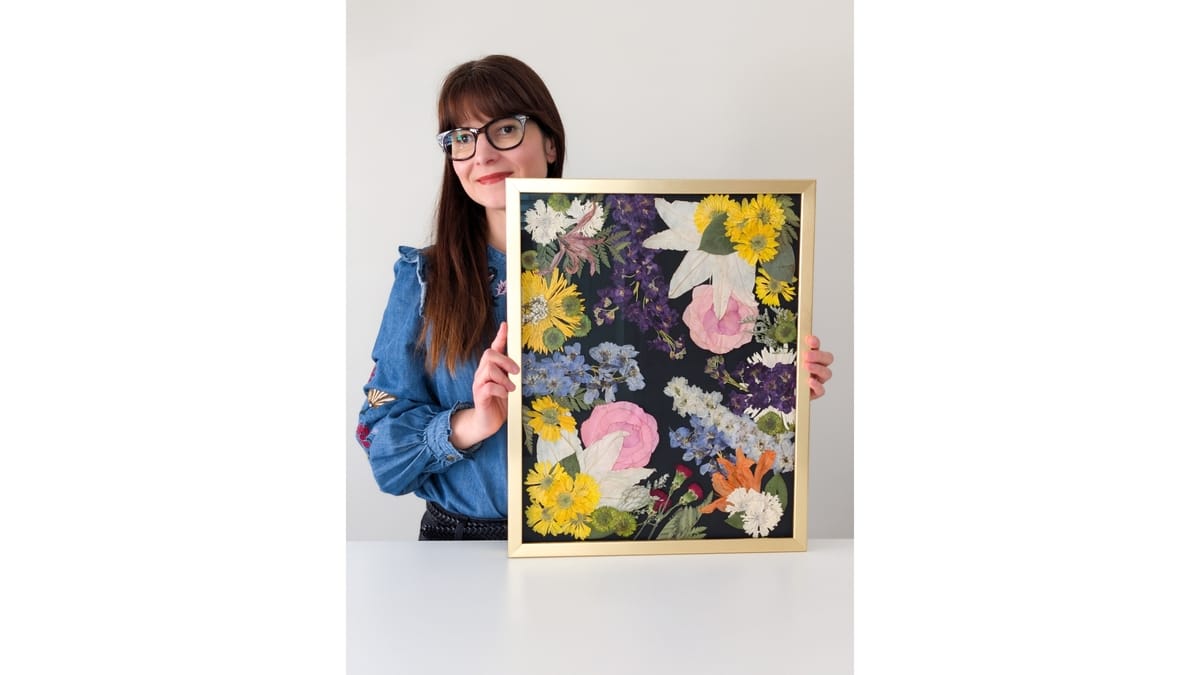

The feverfew on my pressing table looked terrible.
Those cheerful yellow centers, the reason I love feverfew in the first place, had been smashed flat and gone brown under the pressure of my traditional press.
The white petals around them started to separate.
This was the moment I realized that my professional-grade flower press, the workhorse I trust for my wedding bouquets and preservation commissions, was the wrong tool for this particular flower.

Feverfew doesn’t do well in a traditional press.
The accidental discovery that changed how I press small flowers
I’d seen the cotton pad method floating around Instagram and dismissed it. It looked too casual, too improvised.
How could a makeup pad outperform equipment designed specifically for pressing flowers?
Out of options, I tried it with feverfew from my garden.
When I peeled the flowers off a week later, I stared for a minute:
The centers had stayed bright yellow, still slightly puffy.
The petals were white and smooth.
The flowers looked like feverfew again, not some sad flattened approximation of it.
I tried it on other small flowers that had given me trouble, like small fall asters and landscape daisies. It worked every single time.

The color retention and texture of these feverfew blooms are perfect with the cotton pad method.
Why cotton pads work so well for pressing small flowers
Before the how-to, it helps to understand why this method produces results no other method can match for certain flowers.
They’re highly absorbent, so flowers dry faster. Cotton pads pull moisture out of petals quickly, and faster drying is the single biggest factor in color retention. Most flowers finish in 7 to 10 days vs. 10 to 14 in my traditional press.
The cushioned surface protects delicate centers. This is the key difference from a traditional press. Instead of flattening a flower’s center under uniform, unforgiving pressure, the soft pad cradles it. The petals flatten. The center keeps some of its dimension and color.
The surface is smooth. It won’t imprint ridges, weave patterns, or texture onto delicate petals the way corrugated cardboard or some papers can.
They’re cheap and reusable. No screws to tighten, no clamps to adjust. A bag of 180 jumbo pads costs about $18, and once you air-dry them, you can reuse them for many more pressing sessions.
These are the ones I use myself. Good to know that the pads typically have a smooth side and a textured side. Always place the smooth side against your flower.

When to use the cotton pad pressing method
As much as I love this method, it doesn’t work for all flower types. It’s my go-to for small flowers with delicate centers (feverfew, chamomile, fall asters, forget-me-nots, small cosmos, daffodils, columbine, petunias, pansies, etc.)
It doesn’t work for larger blooms that overhang the pad and thick, juicy flowers like dahlias or roses.
If you’re starting out, this is one of the best entry points I know. The equipment cost is almost nothing, and the results will surprise you the first time you peel a bright, intact flower off a stack of pads.
If you’re running a preservation business and pressing bouquets that include small filler flowers, this is a parallel workflow worth building into your process.
During bridal season, I run my traditional press and my cotton pad setup side by side.
Large focal flowers go in the press.
Delicate filler goes on pads.
Better results, and honestly, less micromanaging.
For larger flowers, you can deconstruct petal by petal and press the individual petals on the pads, then reassemble them in your final artwork. More work, but it opens the method up to flowers you’d otherwise skip.

How to press flowers with cotton pads
What you’ll need:
Jumbo pads, 4.7x5.9 inch, with the smooth side identified
A large hardcover book or flat tray as your base
A second large book or flat tray for the top
Heavy weights (I use two 20-lb dumbbells plus a 10-lb kettlebell, about 50 lbs total)
A sunny windowsill, optional but helpful

Step-by-step instructions
Lay your base. Place 2 pads on a large book or tray as the bottom layer. For larger, juicier flowers like grape hyacinth or small daffodils, go with 3 pads for extra absorbency.
Arrange your flowers. Place them face down on the pads, making sure no petals overlap and nothing hangs over the edge. Don’t overcrowd. Give each flower a little breathing room.
Top with more pads. Add 2 or 3 pads on top of the flowers.
Place a sturdy book or tray on top. Make sure it fully covers the pads underneath. Partial coverage creates uneven pressure, resulting in wrinkled petals.
Add heavy weights. I use two 20-lb dumbbells plus a 10-lb kettlebell. You need real weight here. A few books stacked on top won’t cut it.
Choose your spot. A sunny windowsill is ideal. The gentle warmth speeds up drying without cooking the flowers.
Check at day 3. Carefully lift the weights and top book. If the top pads feel damp, swap them for dry ones. Don’t try to remove the flowers yet. They’ll still be sticky and you’ll tear them.
Reassemble and wait another 4 to 6 days. Put the top book and weights back on and leave it alone.
Check for doneness. Flowers are ready when they feel completely dry to the touch.
Peel carefully. Very gently lift the flowers off the pads. Work slowly. If they resist, give them another day.

Troubleshooting common cotton pad pressing problems
A few things tend to go wrong on a first attempt. Here’s what to watch for and how to fix each one.
Flowers stuck to the pads: They weren’t fully dry. Reassemble the setup and give them another 2 to 3 days before trying again.
Brown centers: Usually not enough weight or too much moisture for the pads to absorb. Err on the side of more pads or frequent swaps for dry pads.
Wrinkled petals: The top book didn’t fully cover the pads, or your weights weren’t heavy enough for even pressure across the whole stack.
Petals torn on removal: You’re peeling too fast, the petal is too thin or they aren’t fully dry. Unfortunately, there will be casualties, so press more than you need to account for imperfections.

Perfectly white petals after only 1 week!
The right tool isn’t always the specialized one
The thing I keep coming back to with this method is how much it taught me about pressing in general.
For years, I assumed that a better press meant better flowers. Invest in the right equipment, follow the standard process and get the standard result.
Feverfew taught me something different. Pressing is about matching the method to the flower, not forcing every bloom into the same setup.
Now, your turn: What’s a flower you’ve struggled to press? I’d love to hear in the comments!
Some links on this page are Amazon affiliate links. If you purchase through them, I earn a small commission at no extra cost to you. I only link to products I personally use in my own studio.