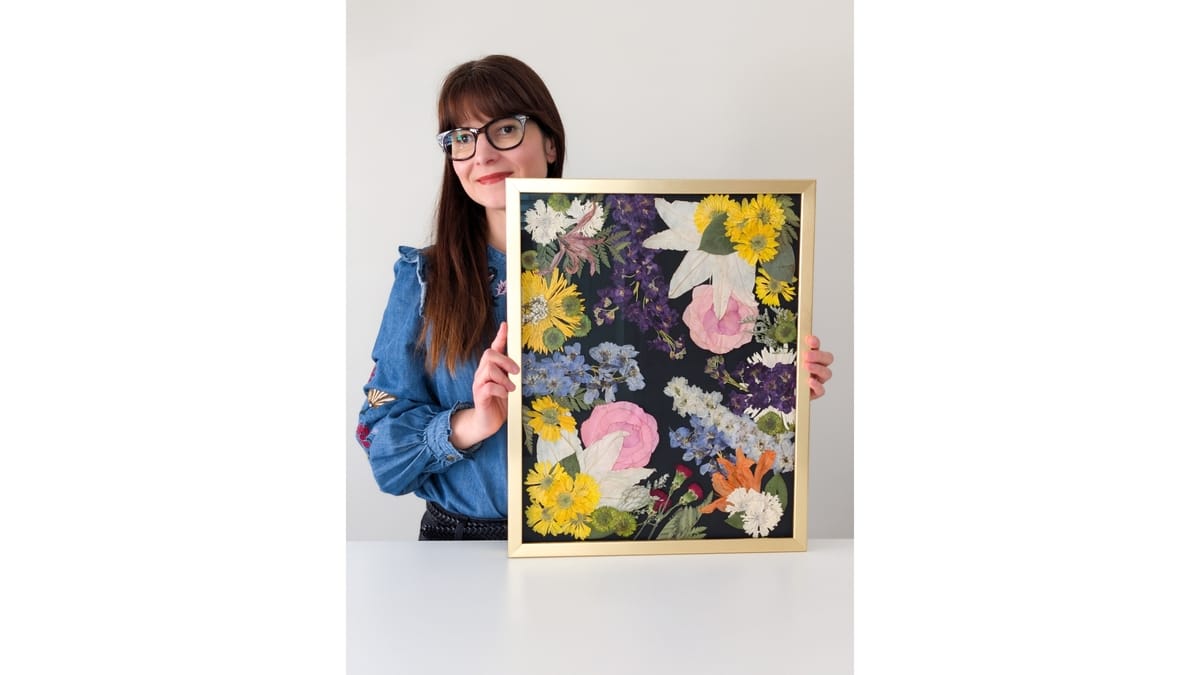
When I started growing my own flowers, I finally understood what I had been missing as a presser. Have you ever bought flowers at the grocery store, pressed them, and been disappointed by muddy colors or wilted petals? Store-bought flowers arrive days or even weeks after harvest, already past their prime for pressing. But growing your own means harvesting at the exact moment the petals unfurl and when the colors are the most vibrant. It also means experimenting with varieties that grocery stores will never carry, like sweetpeas and cosmos.
There is another dimension to growing your own that surprised me: the education. I have learned more about botany, biology, weather patterns, and pressing techniques from my garden than from any book. When you watch a flower develop from seed to bloom, you understand its structure in a way that changes how you approach the press. It’s quite magical!
I put together this guide after experimenting over eight growing seasons in my own front-yard garden. It covers the equipment and setup you need to start seeds indoors, nothing fancy, just basics that will get you started on the right foot. It’s the first step toward growing flowers specifically for pressing. For detailed guidance on 10 hardy annuals that press beautifully in zones 5 and 6, see my flower-by-flower growing and pressing guide.
What you actually need
Good news: Seed-starting equipment does not need to be elaborate or expensive. The initial investment runs around $200, with the grow light being the biggest expense at roughly $100. Everything is reusable season after season!
The essentials:
Plug trays
Grow light
Heat mat
Cookie rack or wire shelf
Small fan
Seedling potting soil
I recommend visiting a local, family-run nursery for supplies. The staff can answer questions, and you avoid the quality inconsistency that comes with ordering online.
What you can skip
Seed-starting kits marketed to beginners often include equipment you do not need. Fancy labeling systems, propagation stations, and humidity domes with built-in vents all add cost without improving germination rates.
Humidity domes deserve special mention because they appear in almost every seed-starting guide. The problem is that most guides assume you are not using grow lights. When you combine a dome with a grow light, the light produces heat that gets trapped under the plastic. I learned this the hard way when I cooked an entire tray of seedlings (and I do mean cooked). The dome, the grow light, and the heat mat created a lethal combination.
If you use domes, you need a small fan for air circulation, and you should never place trays directly on the heat mat. A cookie rack creates the necessary air gap. For most seeds, I skip the dome entirely and compensate by keeping the room warm (70-75°F) and misting the soil surface.
Some seeds do benefit from the humidity dome during germination. Snapdragons, for example, germinate better with a dome, but the dome should come off as soon as the seeds sprout. Snapdragon seedlings actually prefer cooler temperatures once they emerge. Learning which seeds need what conditions is part of the process, and my hardy annuals guide includes this information for each flower.
Grow lights
The grow light is your most important investment. Windowsills rarely provide enough light for healthy seedlings, even south-facing windows in late winter. The light is too weak, too indirect, and too uneven.
Light-starved seedlings stretch toward the source before developing true leaves. They become tall, spindly, and weak. The stem elongates while the plant lacks the energy to build strong tissue. These leggy seedlings often fail when transplanted because they cannot support themselves or recover from the stress of moving outdoors.
Here's the difference: Healthy seedlings look short and stocky. Snapdragons, for instance, should remain compact even after the second or third set of true leaves emerges. If your seedlings are stretching, the light is insufficient.
I started with a clamp-on tabletop light because it was cheaper (spoiler: it was not actually cheaper). The light was insufficient and unidirectional. I had to rotate the trays daily to ensure even distribution, and the seedlings still grew leggy. I wish I had invested in a quality overhead LED from the beginning.
What to look for in a grow light:
LED technology (runs cooler and lasts longer than fluorescent)
Adjustable height or hanging hardware (the light should sit 2 inches above seedlings and move up as they grow)
Adjustable intensity (helpful as seedlings mature)
Wide enough to cover your trays evenly
I now use an overhead LED panel that hangs from ceiling hooks and plugs into a standard outlet. It has three intensity levels and can be raised or lowered easily. Installing a hook or two in the ceiling is a minor project, but the improvement over tabletop lights is substantial.

Run your lights 16 hours per day. I set mine from 6 a.m. to 10 p.m. using a simple outlet timer.
Heat mats
Many flower seeds germinate faster and more reliably with bottom heat. The mat warms the soil to the temperature range that triggers germination.
I run my mats continuously until about 50% of the seeds have germinated, then remove them. You do not need a thermostat controller. The mats are designed to maintain a safe temperature range on their own.
Here's something nobody tells you: mats vary even within the same brand. I have five mats from the same manufacturer, and one runs noticeably hotter than the others. A properly functioning mat should feel warm to the touch, not hot. If a mat feels too hot, test your seeds on a different one or add more airflow.
Never place trays directly on the heat mat. Use a cookie rack or wire shelf to create an air gap. This prevents overheating and allows air to circulate around the soil, which helps the seedlings develop stronger stems. The circulating air also reduces the risk of fungal problems.
Not all flowers need heat for germination. Some, like larkspur and sweet peas, actually require cold to break dormancy. My hardy annuals guide specifies which seeds need heat mats and which prefer cooler soil.
Plug trays
The size of your plug tray cells matters more than you might expect. I use cells roughly 1.5 inches across and 3 inches deep. Smaller cells seem economical because you can start more seeds in less space, but they create a problem: root binding.
When roots outgrow their container, they begin to coil and tangle. A root-bound seedling struggles to absorb nutrients and water. These plants often fail to thrive after transplanting because the roots never properly establish in the garden soil. They may survive, but they rarely flourish.
Deeper cells give roots room to grow downward rather than circling. This is especially important for flowers like sweet peas and larkspur that develop taproots. (Though I recommend direct-sowing sweet peas rather than starting them indoors; they resent transplanting.)

Here's a budget-friendly tip: If you only want to start a handful of plants, repurposed yogurt containers work well. Drill one or two drainage holes in the bottom. The larger volume keeps seedlings happy longer, giving you more flexibility on transplant timing.
I reuse my plug trays season after season. Between uses, I clean them with hot water, soap, and a small amount of bleach to prevent disease carryover.
Seed-starting soil
Not all seed-starting mixes are equal, and the differences matter most for tiny-seeded flowers like snapdragons and poppies.
Look for a fine-textured mix without large chunks. Some mixes contain oversized perlite (the white, squishy granules that improve drainage and aeration) or bits of bark and sticks. Coarse soil buries microscopic seeds too deeply. Seeds that require light for germination, like snapdragons and feverfew, will fail if covered by chunky debris.
I do not pay much attention to brand names. The key is sifting through a bag at the nursery to check the texture before buying. Black Gold is a reliable option, though more expensive than generic mixes. Any fine, fluffy mix without large particles will work.
Always moisten the soil before filling your trays. Dry soil repels water and creates air pockets. Add water gradually and mix until the soil feels like a wrung-out sponge: damp throughout, but not dripping.
A note on soil blocks
You may have heard about soil blocking as an alternative to plug trays. The method uses a special tool to compress soil into freestanding cubes. Seeds are sown directly into the blocks, and roots grow to the edge but naturally stop rather than circling.
The advantages are real: seedlings develop healthier root systems, grow faster, and transplant with less shock. The blocks also eliminate plastic waste from disposable trays.
I tried soil blocking for a couple of seasons and stopped. (I really wanted to love it!) The method requires a special soil recipe that binds properly; regular seed-starting mix crumbles. You need the blocking tool itself. And the blocks are small and dry out quickly, sometimes requiring watering twice a day. It was too messy and fussy for my schedule.
If you grow hundreds of plants and have limited space, soil blocking might be worth exploring. For the hobby gardener starting a manageable number of seeds, plug trays are simpler and more forgiving.
The details that make the difference
After several seasons, I have collected a handful of lessons that I wish someone had told me from the start.
Do not start too early! This is the most common mistake (ask me how I know). You will end up with eager little plants straining toward the light while temperatures outside are still too cold. Root-bound, stressed seedlings transplant poorly. Once outdoor conditions are right (nights consistently above 45-50°F), even late-started seeds grow quickly. It is better to start 2-4 weeks behind schedule than to end up with leggy, root-bound plants that fail in the garden.
A timing issue for me is spring break travel. Most seedlings will die without daily care. I now start most annuals right after I return, usually in early April for my zone 6a garden. The plants catch up fast.
Do not start too many. You will feel terrible culling healthy seedlings because you oversowed. My rule: two seeds per cell, and if both germinate, snip one at the soil line. Pulling the extra seedling disturbs the roots of the one you are keeping.
Fertilize after the second set of true leaves. Seedlings do not need fertilizer until they have exhausted the nutrients in the seed itself. I use Neptune’s Harvest, a nitrogen-rich fish fertilizer, once a week after true leaves appear. Follow the dilution directions carefully. A strong solution will burn delicate seedlings. Fair warning: it smells strongly of fish, and cats will be very interested in your plants!

Water from the bottom. Set your trays in shallow containers and add water to the bottom tray. The soil wicks moisture upward, and the roots grow downward seeking it. Top watering can dislodge tiny seeds and encourages shallow root systems. Bottom watering produces stronger, more resilient seedlings.
Keep air circulating. A small fan running near your seedlings serves multiple purposes: it prevents heat buildup under grow lights, discourages fungal diseases, and stresses the stems just enough to make them stronger. Seedlings grown without airflow often collapse when moved outdoors because they never developed the structural strength to handle wind.
What this setup prepares you for
When the equipment is assembled and the process is dialed in, seed starting becomes genuinely joyful. After a long Midwest winter, watching those first green shoots emerge feels energizing and hopeful. You know your garden will be gorgeous and teeming with pollinators: hummingbirds, honeybees, ladybugs!
And you know something else? Those blooms will become pressed art. Anemones harvested at the perfect moment, larkspur spikes with florets at every stage, bachelor’s buttons in that true blue that holds for years. You grew them yourself, from seed, for exactly this purpose!
What flower gets you most excited to grow and press? Let me know in the comments, I would love to know!
Happy growing and pressing!