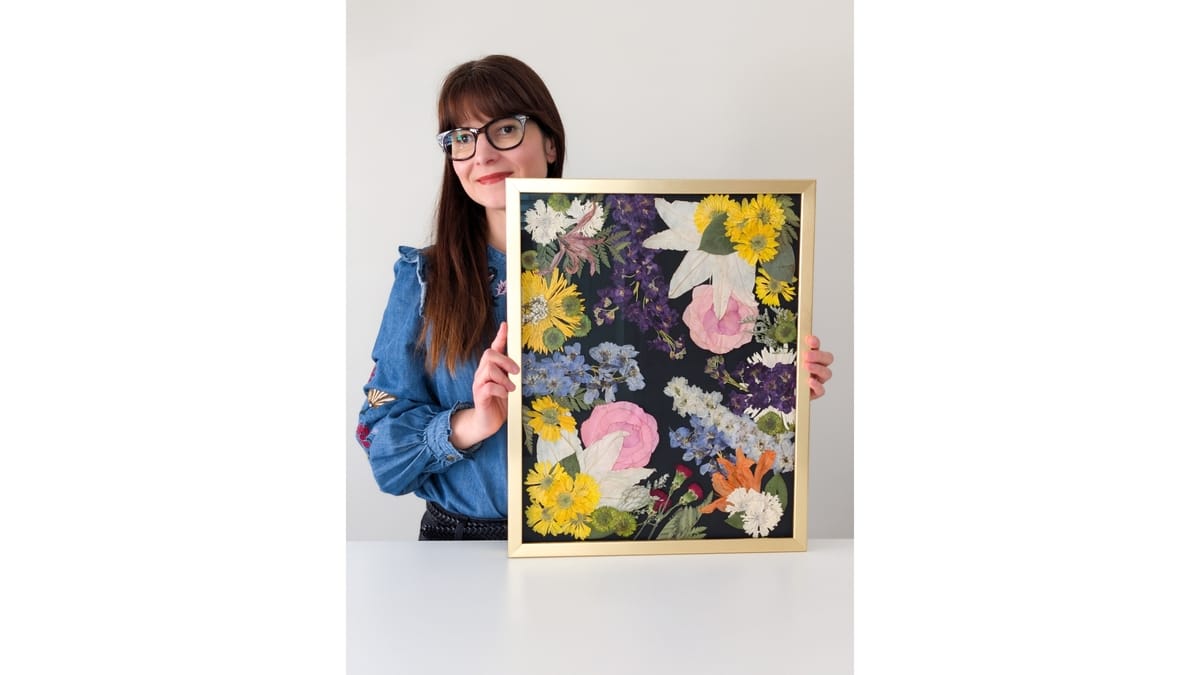
There’s a line that shows up on nearly every flower pressing site, delivered like settled law: white flowers don’t press well. And then the author moves on.
That’s where the advice goes wrong. After pressing tens of thousands of flowers, from my own cutting garden and through hundreds of bridal commissions, I can tell you that sentence is doing real damage. It steers people away from flowers that press beautifully, and it glosses over the ones that actually do need careful handling.
White flowers don’t behave as one category. Some hold their color for years and press whole without complaint. Some transform slowly and wonderfully, deepening into ivory and gold that adds character to finished work. And some do struggle: they yellow, go translucent, or change so dramatically in the press that you have to plan for it.
I grow white flowers specifically for pressing AND I work with them in bridal bouquets where the stakes are higher. That combination gives me a perspective that covers the full range: the artist who chooses what to press for the best results, and the professional pressing whatever comes through the door. This post is for both.
Why white flowers are different
Here’s something worth knowing: white in a flower isn’t usually a pigment. Most white petals appear white because of tiny air spaces inside the petal tissue that scatter and reflect all wavelengths of light at once, the same principle as a white wall. There’s no actual white pigment to fade or degrade.
This matters for pressing because when those air spaces survive the drying process intact, the petal stays white. When they don’t, when cells collapse as moisture leaves, whatever undertones were sitting in the petal come forward. Yellow. Green. Brown. That’s the transformation you see in so many pressed white flowers, and it explains why petal thickness and moisture content are better predictors of success than anything else.
The thin, papery petals of orlaya or feverfew dry quickly and keep their structure. The fleshy, moisture-dense petals of a lily or a garden rose collapse as they dry, and the undertones take over. This is a working theory, not settled botany, but it holds up in practice and it’s the most useful mental model I’ve found for predicting what an unfamiliar flower is likely to do.
Three groups of white flowers
Once you see these three groups, you can’t unsee them. Most of the confusion around pressing white flowers comes from treating them as one thing when they’re really three very different problems.
Group 1: the reliable holders
These are the white flowers that reward you. Thin petals, relatively low moisture, and a structure that survives drying without significant collapse.
Orlaya is the one I keep coming back to. Those flat, lacy umbels dry fast, press whole, and stay a clean white for a year or longer. Queen Anne’s lace and feverfew behave similarly: their tiny petals have very little moisture to lose and very little cellular structure to collapse.
Feverfew (which resembles chamomile) is as reliable as orlaya, especially if pressed with the cotton pad method.
Astrantia (also known as Great Masterwort), though not entirely white, presses incredibly well and retains its color for years thanks to its low moisture content.
Delphinium is another standout. It stays true white for 12 months or more, which is rare in this category. A special note: A variety of white delphinium actually turns light blue during pressing!
Hydrangeas usually press very well and stay mostly white but they do need a couple of paper changes. Pressing them individually ensures the best results.
Nigella, sweet peas (with some of the bulk reduced), and cosmos (the single-row variety not the fluffy ones) also belong in this group.
Veronica deserves its own mention because it’s a perfect example of why method matters as much as flower choice. Without a short microwave burst first, those tiny petals brown in the press within two days. With it, they press white and hold that color for more than a year. Same flower, completely different outcome based on one step.

These astrantias are one year old, with minimal color change
Group 2: the beautiful changers
These flowers press well but transform over time into something different from what you started with. The key phrase is “over time”: the change happens after pressing, not during.
Roses are the most common example. Most white varieties press beautifully and hold a clean color for the first several months. By six to twelve months, they shift from white to ivory to a warm golden blonde. In my personal work, I love these variations. The aged quality adds warmth, and a composition that was cool and stark can become something richer as it settles.
Peonies, when deconstructed (more on that below), also land here: they stay relatively bright white for about a year, then soften gradually.
Ranunculus, which I usually dry in silica rather than press, turns a soft ivory and doesn’t darken significantly over time.
Helebores are easy to press, but they require at least two paper changes. Some white varieties may turn light green, while others remain mostly white, even after a year or so.
The point about this group is that the color change is livable and often beautiful, especially when you know to expect it and can design around it.

Silica-dried ranunculus preserved in May 2025
Group 3: the difficult ones
These are the flowers that change significantly during pressing itself, not over months, but while they’re still in the press. This is where the “white flowers don’t press well” warning actually applies, and it applies specifically here.
White lilies are probably the hardest. Their petals carry a lot of water inside very fine, translucent cellular membranes. As they dry, the petals go translucent and papery.
Orchids are more forgiving but unpredictable: sometimes they hold reasonably well, sometimes they don’t, and you can’t always tell which you’re getting.
Lisianthus is tricky because it varies so much by variety. White lisianthus generally presses to a soft yellow and then holds that color for at least a year, which is a manageable outcome. Double varieties must be thinned substantially before they go anywhere near a press.
White calla lilies are among the more challenging: pressed correctly (microwave first, then traditional press or the dehydrator press), they turn a creamy yellow that’s actually quite beautiful. The trouble is that six months or so later they continue darkening to a deep ivory that needs attention.
White stock catches people off guard because the individual florets look like easy candidates. In most cases, it will brown, and past 12 months it goes brittle and almost melts.
White snapdragons need at least three paper changes to press successfully.
White mums are the hardest flower in my workflow: even after deconstruction, the petals tend to go translucent and dark ivory.
White garden roses, with their many thin petals and full layered form, are prone to browning and wilting in the process and always need to be handled differently from standard roses. I always press the petals individually.
Tulips sit somewhere between groups two and three, behaving unpredictably enough to treat with the same caution as orchids.

This stock I pressed in May 2025 retained its color remarkably well, but it’s rather the exception than the rule.
The deconstruct decision
The single most useful rule for white flowers, or honestly any thick flower: if it has more than two rows of petals, deconstruct it before it goes in the press. When deconstruction would break up the flower, thin out carefully.
Pressing a multi-layered flower whole means the outer and inner petals are drying at completely different rates. That leads to uneven pressure, trapped moisture, and browning. When you deconstruct, each petal or small group of petals gets even treatment, dries consistently, and has a much better chance.
For some flowers, deconstruction isn’t optional:
White peonies
Garden roses
White dahlias
Double-variety lisianthus
White mums
For others, like single anemones, delphinium, or orlaya, pressing whole is fine. When you’re looking at a flower you haven’t pressed before, count the rows of petals. More than two? Take it apart. When in doubt, deconstruct.
A note on garden roses: there’s a useful alternative to pressing. Thin and flatten the bloom under a heavy book for a couple of hours, then move it to silica gel. It isn’t pressed in the traditional sense, but it eliminates a lot of the browning risk. The color will still shift over time, but you preserve the form and avoid the worst outcomes.

Most of these flowers and petals are more than a year old. Notice how differently they retained color.
The microwave question
A short microwave burst in a Microfleur press does something important for certain white flowers: it pulls initial moisture out before the traditional press takes over.
This is not about color. The microwave doesn’t prevent the color changes that are going to happen anyway. What it does is reduce the risk of browning caused by excess moisture sitting in the press too long. Lisianthus, calla lilies, tulips, and orchids all hold water more stubbornly than most flowers. Their cellular structure doesn’t give up moisture easily, and without help, that surplus moisture can trigger browning before the press has done its work. One to two short rounds at 80% power, with condensation wipe-downs between, gives the press a better starting point.
Veronica is the clearest example of the microwave making a decisive difference. Without it, the teeny petals brown within two days. With it, they stay white for over a year. For veronica (including the purple and pink varieties), it’s the only thing that works. Orchids get the same treatment.
If you’re working with a white flower you haven’t pressed before and it has thick or fleshy petals, a short microwave blitz is worth trying before you commit to the traditional press.
Paper changes for white flowers
I change paper more frequently for white flowers than for any other color. My standard schedule is a paper change at 48 hours for everything I press. For white flowers, I do that change at 48 hours and then two more after that.
Any lingering moisture in the press shows up faster on white petals than on darker ones. A small amount of humidity that a red rose might absorb without visible damage can turn the edge of a white petal brown. More frequent changes mean less time for that moisture to sit against the flower. It’s a small extra step and it makes a real difference.
A note on color correction
Here’s something most pressing guides never mention: there are tools that can soften the color changes that happen during and after pressing, without painting the flower back to an artificial white.
Pan pastels are one of them, particularly titanium white and the colorless blender, which softens the discoloration rather than masking it. Applied with a very light touch using a makeup sponge, they can reduce dark undertones and bring a flower closer to its original color without making it look altered. The goal is to soften the warmth so the flower reads better in a composition, not to turn a yellowed lisianthus back to pure white. I use this approach regularly for calla lilies, orchids, and lilies. For anemones, a little pan pastel does a lot of work.
If you do commission work
Bridal flowers often arrive with a long journey behind them. Even when they look fresh, the time from cut to press can span weeks, and that matters for white flowers more than any other color.
The first thing to tell clients with an all-white or mostly-white bouquet is that the flowers will change color in ways that depend entirely on which flowers they have. White roses will warm to ivory. Peonies, pressed and deconstructed correctly, will stay relatively bright. Lisianthus will soften to yellow. That’s the accurate picture, and setting that expectation upfront changes the whole conversation.
What changes the conversation even further is offering color correction. When clients know you have tools to soften the changes that do happen, the color shift stops being a source of anxiety. In my experience, this one detail moves most clients from worried to confident.
It’s one of the real dividing lines between pressing as a hobby and pressing professionally: knowing not just how flowers behave, but how to work with what they become.
The bottom line
White flowers are not a category to avoid. They’re a category to understand. Once you know which group a flower falls into, the reliable holders, the beautiful changers, the ones that need real handling, you can make choices that lead to work you’re proud of.
And when a new white flower lands in front of you and you’re not sure what it’s going to do: count the petal rows, consider a microwave blitz if the petals are thick, change your paper more often than feels necessary, and press it anyway. That’s how you learn.
What white flower has surprised you most, good outcome or bad? Tell me in the comments!
Some links on this page are Amazon affiliate links. If you purchase through them, I earn a small commission at no extra cost to you. I only link to products I personally use in my own studio.