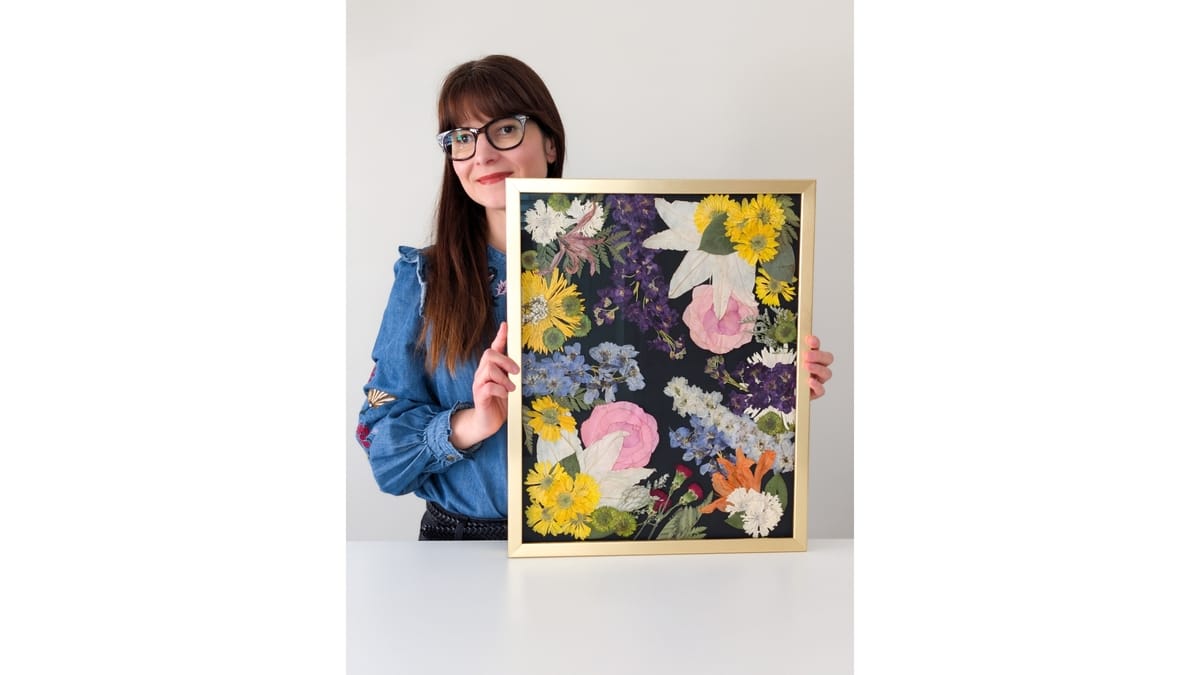

If you find yourself craving a creative, hands-on hobby, flower pressing is the perfect option.
Pressed flowers are an incredibly versatile art medium:
You can frame them as wall art
Create collages
Make jewelry or decor
You don’t need to invest in special equipment to find out if this hobby is for you!
I’m a professional flower preservation artist.
I use a professional flower press for my client work. But when people ask me how to get started, I always point them to the methods in this guide.
They’re simple, they’re inexpensive, and they’re a perfect way to try flower pressing before committing to any gear.
They’re also great if you’re looking for a creative activity to do with your kids, or if you just want to experiment and see what happens.
I recently put all of these to the test on a trip, pressing flowers with nothing more than what I could pack in a suitcase.
They work. So let’s get into it!
Before you start: The two things every method has in common
Flower pressing, at its core, is about two things:
An absorbent material to pull moisture out of the petals
Weight and pressure to keep the flower flat while it dries
That’s it. Every method below is a variation on this theme.
The faster you remove moisture, the better your flowers will look.
Slow drying leads to browning, and browning is the number one frustration beginners run into.
What flowers should you press first?
Start with pansies.
I’ve pressed just about every flower you can imagine, and pansies are hands down the most forgiving for beginners.
They have low water content in their petals, so moisture evaporates quickly and easily.
They retain gorgeous color after pressing.
And they work beautifully with every method in this guide.
Petunias are another great choice. They press into something that looks almost like a watercolor painting.
As a general rule, flowers with thin, flat petals and low moisture content are the easiest to work with.
As you gain experience, you’ll start to develop a feel for which flowers are plump (more moisture, trickier) and which will cooperate right away.
How to prep your flowers
Before you press, you’ll need to do a little trimming.
Cut the stem at the base of the flower head.
You want to remove the bulk of the stem so the flower sits flat.
Don’t cut too close to the petals, though. If you trim right up against the base, the petals will separate and fall apart.
You don’t have to press flowers whole.
You can take petals apart and press them individually, which actually gives you more control over the result.
You can also press leaves and entire stems with the flower still attached for a more botanical look.
If you want to press stems and leaves on their own, they can go on the same layer as your flowers. They dry faster than blooms since they carry less moisture, so they won’t slow anything down.
Method 1: The book method
You might have tried this one already. Maybe you slipped a wildflower between the pages of a paperback years ago and forgot about it. Or maybe you found a perfectly pressed flower tucked inside a book from your grandma’s bookshelf.
Books are self-contained pressing systems: they have absorbent paper built in, and they naturally stay shut without any clips or clamps.
What you need: A hardcover book with uncoated pages (regular novel-style paper, not glossy). Strips of scrap paper for marking. Something heavy for weight.
Best for: Pansies, petunias, individual petals and leaves, larkspur, forget-me-nots, columbines, hydrangea florets (individual florets, not the full flower head).

While I traveled internationally for a funeral, I decided to press a few flowers. These are rose petals I pressed in a book.
How to do it
Grab a hardcover book. Don’t worry about the printed text on the pages. It won’t transfer onto your flowers.
Open the book roughly a quarter of the way in and lay your flowers flat on the page. Arrange them so none of the petals overlap. For a standard-size book, four small flowers per layer is a good limit.
Tuck a small strip of paper in at the edge so it sticks out like a bookmark. This is how you’ll find your flowers later without flipping through every page. (Trust me, you want these markers. Flowers can shift, stick to pages, and become surprisingly hard to locate.)
Leave a healthy number of pages between layers. For a standard book, I’d do a maximum of four layers total. Aim for at least 50 pages between each flower layer. Here’s why: think of the pages as a sponge. The pages closest to the flowers absorb moisture first, and then that moisture gradually spreads outward. If you pack too many flower layers too close together, the paper gets oversaturated and can’t do its job. The flowers sit in trapped moisture and turn brown.
You can also press leaves in the book. Since leaves carry less moisture than flower heads, they’re even easier.
Close the book and stack weight on top. A pile of other books works perfectly. One trick that works really well: place the book on a shelf and stack other books on top of it all the way to the shelf above, then wedge a final book at the top to create steady, constant pressure. You can also place a heavy dumbbell or two on top of the stack. You can also use a milk jug filled with water (just make sure it’s sealed tightly and the outside is dry). The weight is what actually initiates the pressing process. Without it, your flowers will eventually dry, but they’ll end up wrinkled or curled instead of flat.
Set a reminder on your phone for three to four weeks out. This is mostly a set-it-and-forget-it method. You can peek if you’re curious, but be careful. Flowers that aren’t fully dry may stick to the pages and rip as you open the book. Practice delayed gratification!
At the three-week mark, open the book gently and check. If they feel papery and dry, they’re done. If they still feel soft or cool to the touch, close the book and give them another week.
Method 2: The copy paper and brown bag lasagna
This is a variation of the book method that gives you much more flexibility. You can press more flowers, and you can swap the paper partway through the process to speed up drying. I prefer this method over the plain book approach for that reason.
What you need: A large stack of regular office paper (printed paper is fine). Plain brown paper bags, uncoated. A cookie sheet or tray. A large flat surface for the top (coffee table book, cutting board, or another tray). Weights (two 20-lb dumbbells are ideal, about 40 lbs total).
Best for: Most flowers that aren’t very thick. Small roses with a layer of inner petals gently removed to thin them out, delphinium, tulips, daffodils, cosmos, snapdragons.
One thing to avoid: Don’t use paper with marker or water-based ink (like paper your kids scribbled on with washable markers). The moisture from the flowers may reactivate the ink, and you’ll end up with marker stains on your petals.
Also avoid corrugated cardboard. If you look at a piece of corrugated cardboard from the side, you’ll see that zigzag layer in the middle. When you press flowers against it, that pattern imprints directly onto the petals. If you want to use cardboard, make sure it’s smooth, flat cardboard with no internal ridges.

My paper-and-brown-bag lasagna method was perfect for rose petals.
How to do it
Start with your cookie sheet as a base. This makes the whole setup portable so you can move it to wherever you want it to live for a few weeks.
Build your layers like a lasagna:
Start with 4 layers of brown paper bag.
Then 10 or more sheets of office paper.
Then your flowers, laid flat, no overlapping (about 5 flowers per layer for small to medium blooms, fewer for larger ones).
Then 10 or more sheets of paper on top.
Then 4 more layers of brown paper bag.
Repeat for additional layers.
Place a large, flat, heavy surface on top of the stack (a big coffee table book works well), and then add your weights. Two 20-pound dumbbells stacked on top is the sweet spot: stable, heavy enough, and easy to find around the house.
After about 3-5 days, you can change the paper. This is the big advantage over the book method. You don’t have to peel the flowers off the paper. Just keep the sheet with the flowers on it and rebuild the sandwich around it with fresh, dry paper and bags. This pulls out moisture faster and reduces the chance of browning.
After swapping the paper, let it sit for another one to two weeks. Total pressing time is about two to three weeks, depending on the flower.
Method 3: The cleansing pad method
This one surprised me. I discovered it while experimenting, and the results were so good that I now use it in my professional work for certain flowers.
The method uses large facial cleansing pads. They’re designed to be highly absorbent, and they have a smooth surface that won’t leave texture marks on your petals. The rectangular jumbo size, 4.7x5.9 inches, works best. I buy mine on Amazon, and they’re inexpensive.
What you need: Jumbo pads. A cookie sheet or tray. A second cookie sheet or large book for the top. Weights.
Best for: Small flowers like petunias, feverfew, fall asters, cosmos, and any single-layer petal flower that fits within the pad’s perimeter.
How to do it
Check the pads first. Many have one smooth side and one textured side with fine ridges. Always place the smooth side against your flowers.
Build small bundles: 3 pads on the bottom, 1-2 small flowers on top (for pansies, you can fit two small ones or one large one), then 3 pads on top. That’s one bundle.
Create as many bundles as you have flowers. Lay them all out side by side on your cookie sheet. Don’t stack them on top of each other. They’ll be too unstable.
When you’ve filled the tray, place a second cookie sheet or large flat book across the top and add your weights.
Leave it for 7-10 days. Pansies will likely be about 80% dry at the 7-day mark. For full drying, aim for 10 days.
When you check, be very gentle. Don’t use tweezers, especially sharp ones. Use your fingers and carefully peel the flower from the pad. If it sticks and resists, it’s not ready. Give it a few more days.
The pads are reusable. Just let them air dry completely and they’re good to go again. If you want to speed things up, you can replace the top two pads with dry ones after 4-5 days.
Why I love this method
In my professional pressing work, flowers pressed with the pad method retain their center color beautifully. With a traditional press, the center often gets smashed flat and turns brown. The slightly softer cushion of the pads seems to avoid that. For any single-layer petal flower (pansies, chamomile, forget-me-nots, individual hydrangea florets, Japanese anemones), this is my go-to.
The limitation
This method works best for small flowers that fit entirely within the pad’s perimeter. You don’t want petals hanging over the edge. It’s not suited for thick flowers or large blooms like full roses or tulips. For those, you’ll need to deconstruct the flower and press individual petals, then reassemble them later (which is a whole separate skill).
Method 4: The microwave method
This is the most advanced approach, and I wouldn’t call it a standalone method. Think of it as a pre-drying step. The microwave removes a large portion of the moisture quickly, and then you finish pressing with one of the other methods to get that smooth, flat result.
The microwave is especially useful for flowers that are too thick or too moisture-heavy for the other methods. Orchids are the classic example. Orchid petals have a cellular structure that’s almost waterproof (think of a rain jacket: designed to trap moisture inside). If you throw orchids into a book press, they’ll rot before they dry. The microwave solves that.
What you need: A small, low-wattage microwave (cheap and less powerful is actually better here, less risk of burning your flowers). Two small plates with completely flat bottoms (no ridges). Paper towels (you’ll use a lot of these). A ceramic bowl or extra plates for weight (absolutely no metal). One of the above pressing methods for finishing.
Best for: Thicker flowers and high-moisture blooms that would rot in a book or paper press. Orchids, roses, thick-petaled flowers, and anything that feels heavy and plump when you hold it.

Orchids are very difficult to press. Their high moisture content will rot the petals within days, no matter how frequently I change the paper. So first, I use the microwave method and finish pressing them in a traditional press. Here, I used the plate-and-paper-towel method before placing them in the copy paper and brown-bag “press”.
How to do it
Place one plate face-up as your base. Fold paper towels to create about 6-8 layers and lay them on the plate. Place your flower on top. Add another 8 layers of paper towel, then the second plate on top (face-down, creating a sandwich). Place a ceramic bowl or stack of plates on top for weight.
Put the whole thing in the microwave. Set it to 80% power for 30 seconds.
Take it out (careful, it’ll be hot). Remove the damp paper towels and replace them with fresh, dry ones. Reassemble and microwave again: 30 seconds at 80% power.
For pansies, three rounds is usually enough. For thicker flowers like roses, plan on about four to five rounds. Your goal is to get the flower roughly 75% dry.
One thing to watch for: try not to microwave the flower all the way to fully dry. If you do, it tends to come out crinkly and wrinkled. You want it still slightly pliable when you pull it out.
From here, transfer the flower to a book or copy paper sandwich for at least a week. This finishing step is what gives you a smooth, flat pressed flower instead of a crinkled one.
A note on roses in the microwave
Remove petals from the center of the rose, not the outside. If you pull the outer petals first, the whole structure collapses and every petal falls off. Work from the inside out, and do one rose at a time.
A few more tips
Don’t forget about leaves. Leaves with interesting shapes or vein patterns press beautifully and add variety to your designs.
Don’t be afraid to take flowers apart. Pressing individual petals and reassembling them later gives you much more control, especially with thick or complex flowers. You can also create petal mandalas with loose pressed petals, which is a genuinely calming and beautiful art form.
Dry your materials for reuse. Paper towels, cleansing pads, and even office paper can be air-dried and used again. Spread them out somewhere with good airflow and they’ll be ready for your next round.
Be okay with imperfect results. Every flower is a little different. Some will press perfectly on your first try. Others won’t cooperate no matter what you do. That’s part of the process. With practice, you’ll develop an instinct for which flowers are going to be easy and which ones need extra attention.

If you have questions about anything in this guide, or about flower pressing in general, I’d love to hear from you. Comment below to start a conversation!
Some links on this page are Amazon affiliate links. If you purchase through them, I earn a small commission at no extra cost to you. I only link to products I personally use in my own studio.