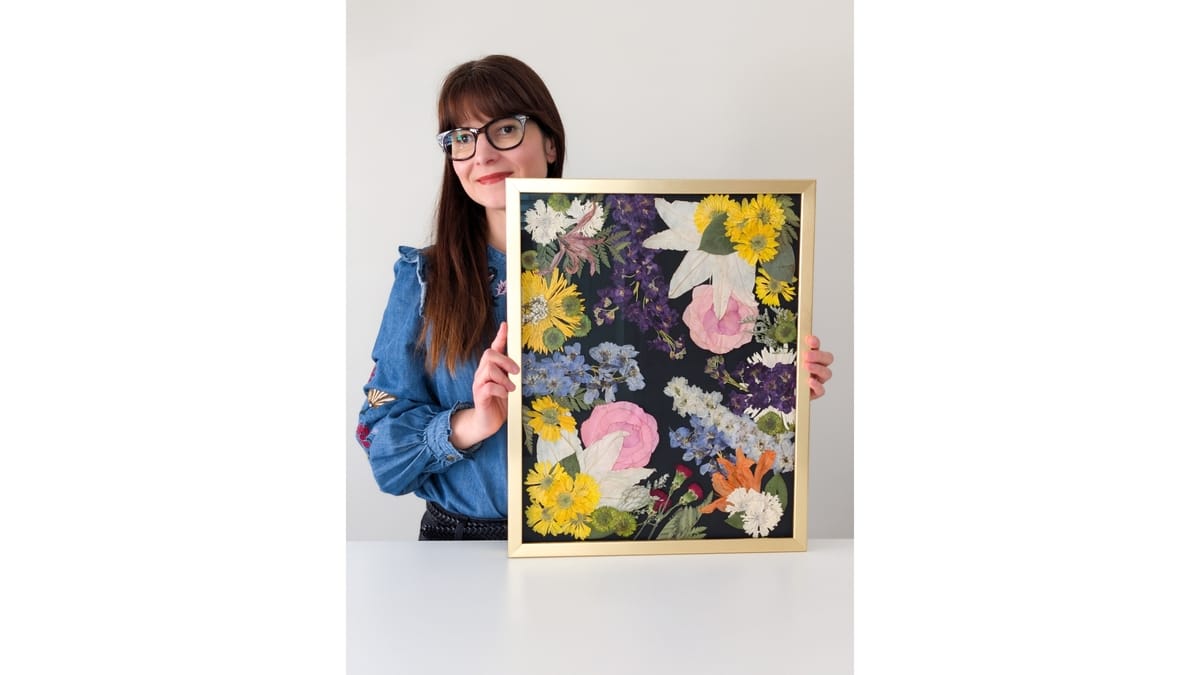

As a professional flower preservation artist, I hear one question more than any other: will it fade?
Yes, pressed flowers fade. Every one of them, eventually.
The real questions are how fast and what slows it down.
So I ran a test: freshly pressed anemones in 4 experimental conditions, with a UV lamp on 24 hours a day for 8 weeks.
Let’s dig into the results!
How I set up the pressed flower fading experiment
I picked 4 nearly identical purple anemones from my garden and pressed them myself. Each got a different treatment:

No treatment. This was my control.
UV spray. Krylon Ultra UV Floral Protectant on the front and back.
Alcohol marker. One layer on the front and one on the back, matched to the flower's natural color.
Marker and spray. Marker first, then spray.
(Quick aside: You might be wondering why I chose alcohol markers specifically. It’s the easiest, most cost-effective method I’ve tried and one of my favorites. I will test other methods in future experiments.)
I mounted each one on paper with a single removable glue dot in the center.
Then I set them about 12 inches under a Zoo Med ReptiSun 10.0, a 26-watt UVB lamp made for desert reptiles.
It ran 24/7 in a dark, dry room from July 20 to September 17. No glass, no daylight, no humidity.
No wall in your home will ever put your art through this, and that was the point.
Which treatment kept pressed flowers from fading?

Left: Flowers on day 1. Right: After 59 days under a 24/7 UV lamp. Notice how the orange labels also faded.
Flower 1: no treatment
The most faded of the 4. The purple washed out to a pale pink, and a cream-yellow band crept along the edges. That yellowing is what happens to untreated flowers over time.
Flower 2: UV spray
This one surprised me. It faded evenly, with no yellowing at all, and looked cleaner than the control.
The catch: the petal edges curled up. The spray seems to tighten the petal surface as it dries, and with only one glue dot in the center, the edges were free to lift.
Flower 3: alcohol marker
The brightest flower on the board. The color stayed even, with no blotching, brown spots, or yellowing.
It still faded some (every flower did), but this one faded the least.
Flower 4: marker and spray
This puzzled me. It faded more than the marker-only flower, and its petals curled like flower #2.
My day 1 photo shows it started a shade lighter than flower 3, even though both got the same marker.
My best guess: this bloom had weaker pigment from the start.
I'm calling it inconclusive. It still didn't yellow, and it ended up deeper in color than both the control and the spray-only flower.
How to keep pressed flowers from fading: 3 lessons from my experiment
If you want your pressed flower art to hold its color longer, here's what this test taught me:
If you use UV spray, glue down the entire flower, edges included. A center dot isn't enough. Spraying does seem to slow fading, though I’d want to repeat the test with other types of flowers.
If you use both, color first, then spray. That way the spray sits on top of the marker, providing extra protection.
Treat every flower in your artwork, or none at all. Over time, treated flowers outlast untreated ones, and uneven fading looks worse than even fading.
How long do pressed flowers last on a wall?
For a real-world comparison, here are purple sweet peas I framed in 2022.

2022 sweet peas framed with museum glass
They're untreated and behind museum glass, which blocks most UV. It’s been hung on a hallway wall without direct sunlight.
Four years later, the purple has pulled back to speckles along the petal edges and veins, and the rest has gone parchment beige.
Museum glass helps a lot, though it won’t stop natural pigment breakdown.
My rule of thumb: Even when displayed well, expect visible fading on untreated flowers after a year or so. How much depends on the variety, the color, the condition it was pressed in, and where it hangs.
Why I use alcohol markers to color correct pressed flowers
Markers handle almost half of the color correction in my studio. This test showed why:
They're cost-effective and look natural. The ink tints the petal instead of painting over it, so you still see the veins and texture.
They're buildable. One layer gives a soft boost, and more layers deepen the color.
The color range is wide, so you can match the flower's real shade.
In this test, they kept the petals flat.
One caveat: alcohol markers aren't lightfast. They slow fading, and a piece hung in direct sun without UV-filtering glass will still lose color.
Want to learn the alcohol marker method?
You’re in luck! I just launched a mini-course that covers everything I know.
Shade matching, application technique, color chart… all in a 30+ page PDF guide and 40+ minutes of video.
And I’m so confident that you’ll love this course that I offer a 30-day refund.
What I will be testing next
One of my next experiments will compare at least 3 color correction methods. I also plan to test regular and museum glass on untreated flowers. It will take me several months to run these tests, but they will be worth it!
Have your framed pressed flowers faded? Tell me in the comments which colors went first.