
Back in 2021, a friend of mine looked at a pair of polymer clay earrings I'd made (little resin-set pressed flower pieces, my first attempt at turning the flowers I'd grown into something wearable) and said, "You should sell these."
My first reaction was something between flattered and terrified. I was working full-time. I had no plan. But I was curious about one specific thing: did what I made with so much joy mean enough to someone else to actually pay for it? So I made a few more pairs, posted about them in a local Facebook group, and waited.

My first sellable pressed flower creations featuring hydrangeas and dill flowers
My friend was the first buyer. She got compliments on those earrings for weeks. And the confidence that gave me was enough to take the next small step.
If you've ever had someone look at your pressed flower work and say something similar, this post is for you. Because that moment - flattering, terrifying, a little bit thrilling - is worth paying attention to.
Before anything else: know what you actually want
The question "could I sell this?" sounds like one question. It's really several questions wearing the same coat.
Are you looking for a little pocket money on weekends, selling at a local market a few times a year? Do you want a side income that runs in the background while you keep your day job? Or are you sitting with a longer-term thought - something like, could this eventually become my whole thing?
The answers lead somewhere different.
My own goal started as pure curiosity and evolved from there. Each selling decision I made built on the one before it. I wasn't strategic about it at first. I made things I genuinely loved making, posted them, and paid close attention to what people responded to. The market told me what to make more of. I didn't have to guess.
But here's what I've seen trip people up: going in without any goal at all. When a bad day happens (and it will, more on that in a minute), having no sense of why you're doing it means there's nothing to hold onto. A clear goal, even a loose one, is what keeps you going past the first hard moment.
What "good enough to sell" actually means
Most people who ask this question are asking the wrong thing. The work is usually fine. The flowers are pressed well, the colors held, the composition is pretty.
What selling actually requires is something slightly different: does your finished piece look crafty, or clean, with a touch of sophistication? Is it unexpected in some way, something a buyer couldn't easily find elsewhere, or replicate themselves?
That last test is the one I always come back to. A picky buyer will look at something, think "I could make that," and walk away. You want to make something where the honest answer to that thought is: probably not, actually.
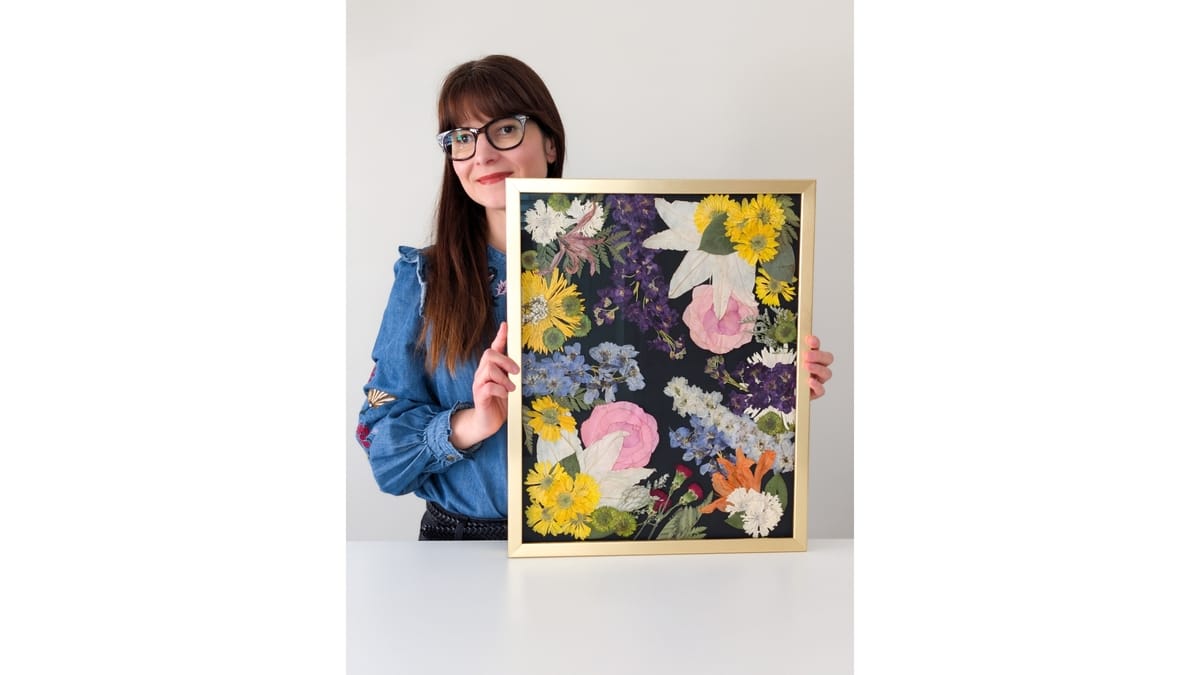
Once you’ve mastered pressing, the gap between hobby work and sellable work is almost never a matter of skill. It's presentation. It's the choice of frame, the mat board, the overall design, or the way the piece is photographed. It's the decision to press well one dramatic peony rather than a scatter of small flowers. The craft can be exactly the same; the result reads differently.
Where to sell and the tradeoffs you should know
The two main options are in-person markets and online, and they're different experiences.
Markets give you immediate feedback, not just from what sells, but from body language. You can watch someone pick up a piece, study it, put it down. That information is gold. Cash in hand the same day is satisfying in a way that a Venmo notification at 2 a.m. never quite matches. The downside is that markets require inventory, setup, physical presence, and energy. I'm a natural introvert - I love people, but big crowds drain me. I still did markets. I learned a lot from them. I also found out they're not my long-term plan.
Online has a longer ramp. Creating product listings, photographing work well, figuring out how people will actually find you… it takes time and some comfort with technology. It worked for me because digital marketing was my day job for 20+ years. If that side of things feels foreign, the learning curve is real. The upside is that an online shop works while you're asleep, while you're pressing more flowers, while you're living your life.
Physical stores are a third option that doesn't get talked about enough, and one I've used both ways:
Consignment: a shop owner displays your work and takes a cut (usually 30–50%) when it sells - you keep ownership until then, but that commission takes a real bite.
Wholesale: the owner buys your pieces upfront at a lower price, typically half your regular retail. You get paid immediately and walk away, but you'll need to price your work carefully so the wholesale number still makes sense for you.
The upside of both store-based arrangements is visibility without the work of running your own sales channel. Someone else's foot traffic becomes your audience. The downside is that you give up margin, and with consignment you also give up certainty - pieces can sit for months. It works best when the shop's customers are genuinely your people: gift buyers, home decor shoppers, anyone drawn to handmade work with a story behind it.
So what selling option should you choose? The right answer depends on that goal you identified earlier and your natural preference. Someone building toward a real income will likely need to try all eventually. Someone who wants a pleasant Saturday selling experience twice a year has a simpler answer.
The part I wish someone had told me earlier
My first market was a total bomb, despite it being an upscale, holiday event in Chicago. I had made inventory, set up a table, told everyone I knew about it… and it just didn't work.

My first market bombed… and my face says it all.
I didn't quit, but I want to be honest about why: I had a longer-term goal in mind. I wanted to get good at this, to figure it out. That gave me somewhere to stand when the first bad experience hit.
Selling changes your relationship with your craft. Some people discover they love the business side of it: the feedback, the customer conversations, the problem-solving. Some people realize, fairly quickly, that they'd rather press for the joy of pressing and leave the selling to someone else. Both of those are completely valid outcomes.
What I'd encourage you to avoid is forcing something that feels fundamentally wrong for you. I found out that big in-person markets weren't my thing. So I pivoted toward bridal work, small workshops and educational content. That pivot didn't mean giving up. It meant paying attention.
Three things that matter more than talent
If you’re inclined to sell your creations, here's what I'd actually focus on:
Consistency. Can you reliably produce work you'd be proud to charge for? Not every piece: some will be experiments, some will be failures. But do you have a baseline you can reproduce?
Presentation. Think about how the finished piece looks as a whole: the overall design, the finishing details, and the way you photograph or display it. A framed piece that looks thoughtfully composed reads differently from one that looks thrown together, even if the pressing technique is identical. The same goes for jewelry, resin pieces, cards — whatever you make. The pressing can be beautiful and the presentation can still let it down. Ask yourself honestly: does this look like something worth paying for, or does it look like something I made for myself? That gap is almost always closeable, and it’s where the real work is.
Willingness to learn the business side. Pricing, customer communication, figuring out what to make and why… none of this is intuitive at first, but it’s all learnable. The pressers I've seen succeed are the ones who stayed curious about this part, not the ones who were the most technically gifted.
Now let me know in the comments: Has anyone ever looked at your work and told you to sell it? What did you do with that thought?