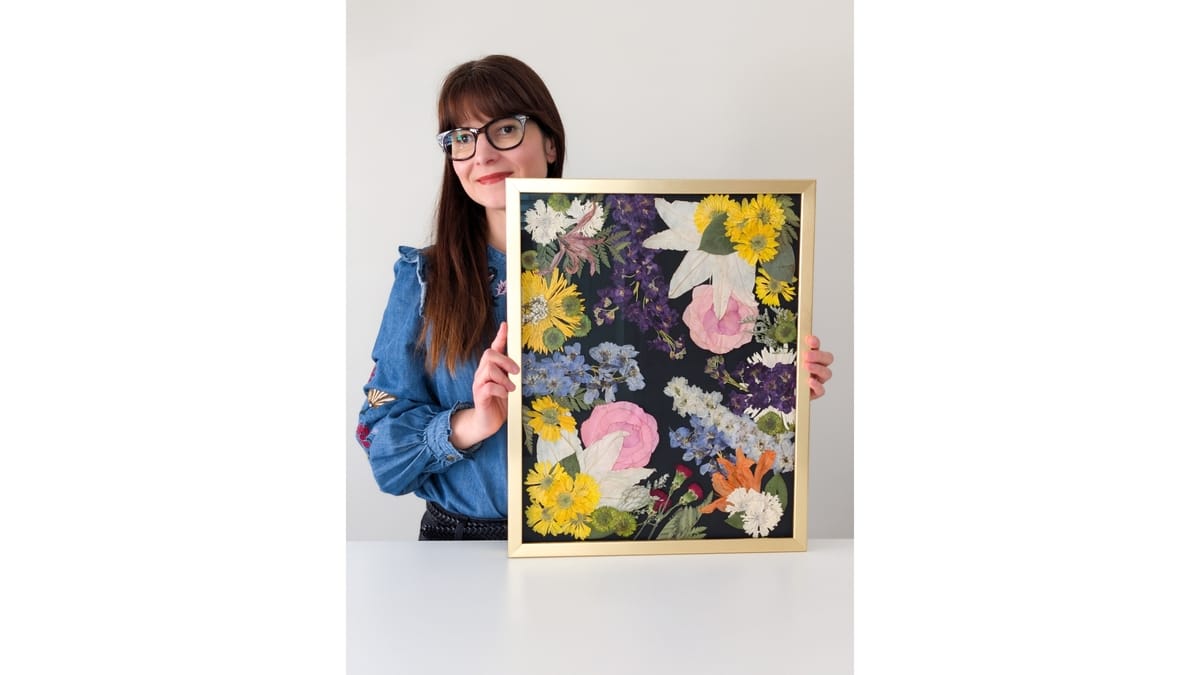
Nobody wants to think about bugs in their pressed flower art.
If you frame pressed flowers, especially if you sell them, this is one of those topics worth facing head-on.
Pressed flowers are dead plant material. And a handful of common household insects eat exactly that kind of thing.
Unless you work in a tightly controlled, climate-managed environment, you cannot remove the risk of bugs completely.
What you can do is lower it. A lot.
This post is what I actually do in my own home studio, alongside what the museum and conservation world has learned from keeping dried plant collections intact for decades. I press in a normal house, not a tightly-controlled studio environment, so everything here is built for real conditions.
None of it is a guarantee, but it will help stack the odds in your favor.
Before we dig in, a quick disclaimer: I am NOT an entomology expert or pest control professional. This post draws from my personal experience and research I did. Please take everything with a grain of salt and adapt it to your own circumstances.
The bugs that actually go after dried flowers
A few small household beetles and their larvae are the real culprits.
They feed on dried plant and animal matter: things like wool, dried food in your pantry, dead insects, and yes, dried and pressed flowers. In almost every case, it is the larvae doing the eating, not the adult beetle.
Here is the detail that tells you how real this is.
Entomologists nicknamed one of these beetles the "herbarium beetle" because of how reliably it turns up in dried plant collections. Museums that store pressed specimens have fought these insects for as long as they have kept the collections.
The other thing worth knowing is the hardest part to accept:
The eggs are essentially invisible, and they can ride in on the flowers themselves.
A bug or its eggs can arrive tucked inside a dried bouquet or a bundle of foraged stems long before you ever sit down to make anything. You would never see them.
That is exactly why prevention has to start before the flower goes anywhere near a frame.
Why a sealed frame is not a sealed vault
It would be lovely if sealing a frame settled the whole question. Unfortunately, it does not.
These beetles can chew through paper, cardboard, and even thin materials to reach food.
Sealing a frame is genuinely worth doing. It keeps out dust, slows moisture, and puts a real barrier in a determined insect's way.
But no seal you can build at a kitchen table is truly bug-proof.
You should still seal your frames, but the work you do before sealing matters more than the seal itself. If the flower goes into the frame already clean and treated, the seal becomes a second line of defense instead of your only one.
What actually kills them
Two things reliably kill insects at every life stage, including eggs: enough heat, or enough cold for long enough.
Both are used in professional conservation. Both are doable at home, with some honest caveats.
Heat
For most of these household pests, the lethal zone sits around 122 to 131°F (50 to 55°C).
Get the material meaningfully above that and hold it there, and you kill what is present.
My own method runs at 150°F (66°C), which clears that threshold comfortably.
One honest note: museum conservators actually caution against oven-heating delicate specimens too aggressively, because high heat can damage the internal structure of petals over time.
So I treat 150°F (66°C) as my own tested practice, not a rule I am handing you as gospel. Watch your flowers, and pull back if they show any sign of scorching or curling.
Cold
Freezing is the method museums lean on most, and it works, with a catch that matters at home.
The conservation standard is roughly 72 hours at around -22°F (-30°C), or about two weeks in an ordinary home freezer.
Freezing it for a few days or a week may not be enough, and here's why:
Home freezers run warm. Most sit around 0°F (-18°C), which is at the very edge of the effective range, not comfortably inside it.
Slow cooling lets insects adapt. When the temperature drops gradually, some insects have time to mobilize natural antifreeze compounds and survive a cold snap that would otherwise kill them.
Eggs are the toughest stage. They resist cold better than adults or larvae, and freezing sometimes damages them without reliably killing them.
The fix is not complicated. If you freeze, give it the full two weeks, keep the freezer as cold as it goes, and do not count on a quick three-day chill to do a two-week job.
What I do in my own home studio
Here is my actual routine. It leans on heat, because that is what has worked for me.
Heat before storage. Before pressed flowers ever go into storage, I put them in the oven for 30 to 40 minutes at 150°F (66°C). They sit stacked between plain paper with a book on top to keep them flat.
Heat again before framing. Right before I am ready to frame a piece, I put the mat in the dehydrator or oven for about 30 minutes, again at 150°F (66°C). Large mats that do not fit go on top of the dehydrator, cranked up higher.
My thinking is simple: heat kills the kinds of bugs and eggs that are likely to hitchhike, and doing it twice covers both the storage stage and the final framing stage.
Then there are the frames themselves. I have made two deliberate changes to what I offer:
I stopped offering floating frames. They can be difficult to seal against insects.
I discontinued hinged brass frames that do not fully close. If a frame cannot shut completely, it cannot do its part of the job.
Once a frame is tightly secured, I glue paper to the back to keep most bugs from finding their way in.
I do not use tape for this, but tape is a perfectly good option as long as it is archival. Regular tape yellows, dries out, and lifts over time, which defeats the purpose.
None of this makes a frame invincible. It makes it far less hospitable, which is the honest goal.
What to do: your risk-lowering checklist
Here is the practical stack, from the flower all the way to the finished sale.
In your home studio
Start clean and fully dry. A flower that went into the press damp, or came out not quite finished, is the most vulnerable of all. Make sure everything is bone dry before it becomes art, and let glue dry completely before you seal anything inside a frame.
Treat for pests before framing. Whether you use heat as I do or a full two-week freeze, do it before the flower goes into the frame, not after.
Keep humidity down. Damp air feeds mold and makes flowers more inviting to pests. A dehumidifier in the studio and/or air conditioning will do the trick in most cases.
Choose frames that close completely. Skip any frame that cannot shut all the way. A frame that seals is doing half the work for you.
Add a backing barrier. After securing the frame, glue paper to the back, or use archival tape around the inner edges of the back of the frame. It is not bug-proof, but it raises the wall.
A care card for market sellers
If you sell at markets or fairs, a small card tucked in with each piece sets honest expectations and protects the relationship. Here is wording you are welcome to adapt:
Your pressed flowers are real botanicals, preserved by hand. To help them last, keep your piece out of direct sunlight and away from damp or humid spots like bathrooms and exterior walls. Natural flowers may soften or shift in color slightly over time. That is part of their beauty and the proof they are real. With gentle care, your piece can stay lovely for years.
It costs almost nothing, and it heads off the two most common ways a piece gets damaged after it leaves you: sun and moisture.
A contract clause for commissions
If you do commissioned work, preserving someone's wedding or memorial flowers, your agreement should be clear about what you can and cannot control once the piece is in the client's home. Here is sample language to start from:
Pressed and preserved botanicals are natural materials that change over time. The artist takes every reasonable precaution to prevent pests, moisture damage, and deterioration, including treating materials before framing. The artist cannot, however, guarantee against natural aging, color change, environmental exposure, humidity, or pests introduced after the finished piece leaves the studio. Care of the finished artwork, including keeping it dry and out of direct sunlight, is the responsibility of the client.
One important note: I am a flower presser, not a lawyer, and this is sample wording, not legal advice. Adapt it to your own situation, and if the stakes are high for your business, have someone qualified look it over. The goal is simply to make your promise, and its honest limits, clear out loud before there is ever a problem.
The honest bottom line
You cannot promise a pressed flower frame will never, ever host a bug. No one working outside a controlled, museum-like environment can.
What you can do is treat your flowers before they are framed, choose frames that actually close, seal the back, keep your studio dry, and tell your buyers the truth about caring for natural materials.
Do those things, and the odds tip hard in your favor!
Scientific and conservation sources
For anyone who wants to read the research behind this post, here are the sources I drew on. I leaned on museum and herbarium conservation bodies and university entomology programs.
National Park Service, Conserve O Gram 11/12: Preparing and Storing Herbarium Specimens: guidance on drying temperatures and freezing to eliminate pests in pressed plant collections.
MuseumPests.net (Integrated Pest Management Working Group): Low Temperature Treatment: freezing protocols and durations for killing insect pests at all life stages.
Smithsonian Institution Archives: Integrated Pest Management, Freezing: the -20°F (-29°C) for 72 hours standard and the extended time needed at warmer freezer temperatures.
Canadian Conservation Institute, CCI Note 3/3: Controlling Insect Pests with Low Temperature: why cooling rate matters and how insects survive slow freezing.
University of Maryland Extension: Carpet Beetles: identification and feeding habits of the beetle larvae that damage dried materials.
Oklahoma State University Extension: Drugstore Beetle and Cigarette Beetle: the pantry beetles that feed on dried flowers, and their ability to chew through packaging.
Kansas State University, Stored Product Protection: Extreme Temperatures: thermal death points for stored-product insects, the basis for the heat-treatment thresholds.
Royal Botanic Gardens, Kew: Battle of the Booklice: how a working herbarium monitors and manages the insects that attack dried plant material.
Now I would love to hear from you. What do you do to protect your framed pieces from pests and moisture? Have you landed on a sealing or treatment trick you swear by, or run into a problem that taught you something? Tell me in the comments.