Several years ago in late spring, I was cutting back wilted daffodil foliage in my front yard.
I was incredibly frustrated that I had to do it.
The leaves looked like they were melting into the ground, yellow and mushy. I heard myself mutter, “I hate gardening.”
I thought it was a waste of time and I didn’t get its appeal.
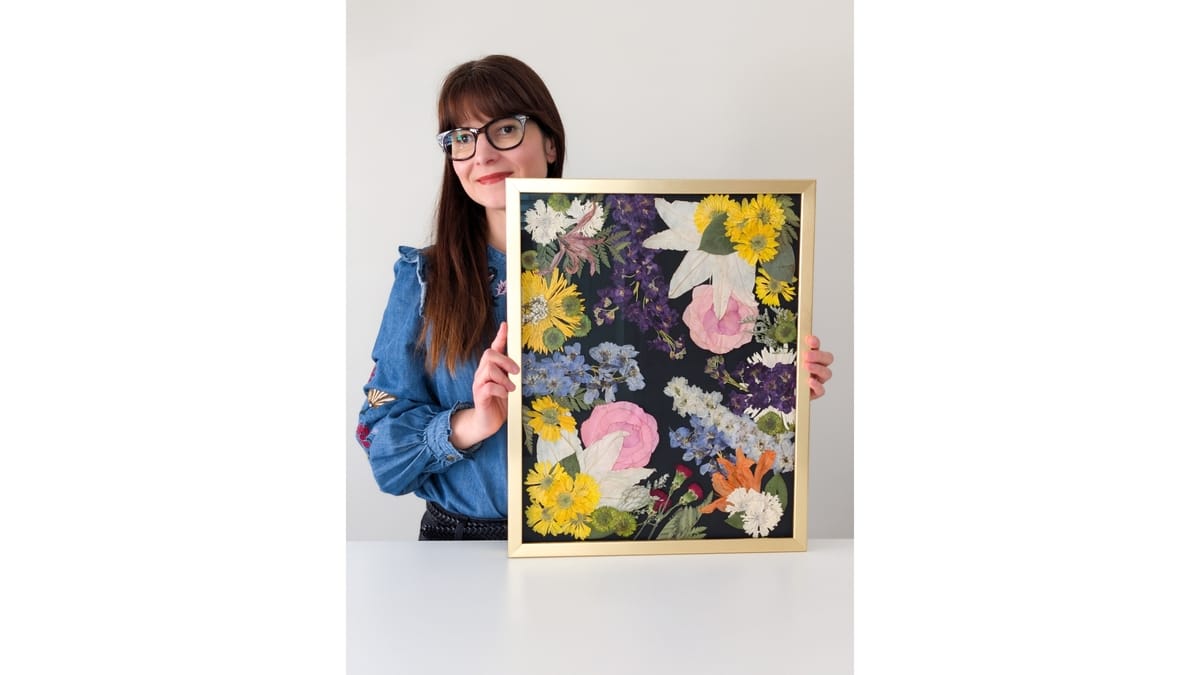
Today, not only do I grow flowers from seed every year, but I left my corporate job to be a professional pressed flower artist.
This is my story.
The magical garden of my childhood
I grew up surrounded by my grandmother’s incredible flower garden.
I spent all of my childhood summers at my grandparents’ house, in the outskirts of Bucharest, Romania’s capital.
I was surrounded by hundreds of flowers, a welcome break from being cooped up in my parents’ one-bedroom apartment in a Soviet-style high-rise.
In a small front yard, she grew dahlias, many kinds of roses, tuberoses, gladiolas, hydrangeas, a sour cherry tree, a peach tree, rudbeckias, cosmos, stonecrop, poppies, phlox and many others that I can’t remember.
People passing by would stop to admire the garden and if she was outside, inevitably, she would strike up a conversation with them.

Sometime one summer in the late ‘80s, with my grandma in her magical garden
I studied every flower.
Smelled them, stole petals to stick to my nails, looked for seeds, caught butterflies by their wings.
I would hide between the dahlia rows for what felt like hours, examining leaves and listening to my grandfather’s scratchy transistor radio drifting from the porch.
There was no TV worth watching (programming was limited to evening propaganda news and some weekend cartoons).
The garden was my entertainment and my education.

Part of the front yard and garden, which my grandpa built with his own hands, from pouring the cement, laying the marble mosaic and building the metal fence and gate.
Decades later, when my husband and I bought our first house, I tried to keep houseplants. Then some perennials in the yard.
I always ended up over or underwatering them, then neglecting them entirely.
Whenever the subject of growing any kind of plants came up, I’d just say that all I could do to plants was kill them.
A few zinnia seedlings walk into my life
Mother’s Day 2019.
My daughter, then in third grade, brought home a plastic cup with a few spindly seedlings cautiously stretching out.
“What are these?” I asked.
“Zinnias! I grew them at school,” she replied.
I had no idea what she was talking about. I was impressed that my 9-year-old had accomplished something that I never could: grow a plant from seed.
I took the cup and put it on the kitchen windowsill, thinking, what could I do to keep the seedlings alive, at least until my daughter forgot about them?
Later that day, I googled “how to grow zinnias” and read some information on the Chicago Botanic Garden website.
“Low maintenance.” “One of the easiest flowers to grow.” “Thrives in any soil.”
Hmm, maybe I can give these baby plants a try, I thought.
A few days later, I dug a small hole in a mulched corner of our front yard, watered and walked away.
Over the next few days, I checked on the clump of seedlings (I didn’t thin them; the concept of plant spacing didn’t exist to me).
They kept going. And going. And going.

My daughter’s zinnias
Riding a wave of optimism, I started to read all the books on container gardening that I could find at the library.
I absorbed every bit of information and started to realize that you are not born a gardener; you become one when the time is right.
And the zinnias? They kept on going and gave back in the most unexpected way.
When the first zinnia buds bloomed, I called my mother to show her how well they were doing.
I turned the camera on and the second she saw them, she exclaimed: “These are zinnias, grandma’s favorite flowers!”
I was speechless.
This accidental flower growing in my first-ever garden took me back to my childhood and brought a rush of warm memories.
“Grandma always wanted a painting with zinnias to hang on the living room wall,” continued my mom. “Do you remember the poppy flower painting I bought her?”
I did.
“I got that one because I couldn’t find one with zinnias. She liked it but regretted not having her beloved zinnias instead.”
Zinnias. The lovely, unfussy bloom that entered my life on Mother’s Day 2019 thanks to my daughter.
Just like a tiny seed waiting for the right conditions to sprout, my love for gardening awoke and has grown fuller and stronger ever since.

The zinnias my daughter grew from seed attracted so many butterflies.
The encyclopedia and the microwave
Here’s the thing about seeds. Some of them sit dormant for a very long time before the conditions are right.
The very first time I pressed a flower was in fifth grade, in Botany class. (In Romania, we were lucky to study individual science classes like Botany, Zoology, and others.)
They were weeds I had picked up as an experiment, and I stuck them in an encyclopedia that weighed a few pounds.
They turned brown. I still remember it.
That memory sat untouched for decades. Then 2021 happened.
By my third growing season, my pandemic garden was bursting with flowers. I decided to experiment with pressing, just for fun. I started with a microwave press and became completely obsessed.
I pressed every type of flower and foliage from my garden and more that I scavenged from wherever I could find them.
I was mainly interested to see if there were any limits on what I could press, from delicate cosmos to puffy dahlias.
I experimented for months, pressing hundreds, if not thousands, of flowers.

My first microwave press, ready to preserve dahlias from my garden
Later that year, I invested in a traditional press, and many more after that.
Each one taught me something new about pressure, moisture, timing. The kind of knowledge you can only build by doing the work.

Some of my first pressed flowers
The midnight commission
In the fall of 2021, while still working full time as a writer at a large consulting company, I decided to form my own official pressed flower practice.
I called it Bloom & Make.
I advertised locally some of the things I had created with my pressed flowers: jewelry, decor, artwork.
I was genuinely surprised by what happened next.
People loved it.
Strangers, not just friends, bought everything I had created. Dozens of people reached out, commissioned pieces and told me what my work meant to them.
My first official art commission was a gift for a new bride. I remember sitting at my kitchen table pressing those flowers well past midnight, completely absorbed.

Flowers from the first commission I ever took
That response gave me the confidence I didn’t know I had.
For years, I’d worked as a corporate writer and editor. I was good at it. I liked the marketing world, writing stories about brands and finding ways to engage audiences. I’d spent decades doing it.
But here’s what I could never quite get used to: nothing I created was ever mine.
In that kind of environment, there’s no way to measure whether something you wrote actually mattered to someone. You hand it off and it disappears into the machine.
Pressing someone’s flowers is the opposite of that.
When I preserve a bride’s bouquet or a memorial arrangement, I know exactly what it means to the person receiving it.
I’m leaving something behind in someone’s home that they’ll keep for years, maybe decades.
That’s a joyful feeling, and a humbling one.
The fire under my feet
For about a year and a half, I ran both worlds: the day job and Bloom & Make.
By early 2023, I’d realized there was incredible demand locally for wedding bouquet preservation.
But because I was still working full-time, I had to choose a direction: make my own art or bridal flower preservation.
I chose the latter.
Then I spent the next three years wrestling with an even bigger decision - whether I should keep my day job or dedicate myself fully to flower preservation.
Keeping both was becoming unsustainable and was taking a toll on my mental health.
So I left my corporate job in September 2025.
Changing careers after 40 is scary (I won’t pretend otherwise), and I wrestled with it for a long time.
I felt like I owed it to myself to try.
I knew that I would regret not doing it. And I wanted to feel the fire of being fully responsible for the success of my business, which is hard when you spend most of your energy in a 9-to-5.
Since 2021, I’ve pressed tens of thousands of flowers and worked with over 400 clients.
My writing and marketing background turned out to be exactly the toolkit I needed to build a business from scratch.
I draw from that experience daily.

A career pivot in my 40s turned out to be the best decision I ever made
If you’re someone who wants to grow beautiful flowers and preserve them (whether that’s for your own home, for gifts, or because you’re thinking about turning it into something more), you’re in the right place.
That fifth-grade botany experiment with weeds in an encyclopedia, hiding between my grandmother’s dahlia rows, my daughter’s zinnia seedlings on Mother’s Day: none of it happened on a schedule.
All of it happened at the right time.
